SEO And Its Value In Modern Digital Marketing
Search engine optimisation (SEO) is the disciplined practice of making your website more visible to people actively seeking information, products or services. For Manchester businesses and organisations, SEO sits at the heart of sustainable growth, combining technical excellence with content relevance to attract meaningful traffic. When implemented with care, optimisation translates visibility into qualified enquiries, revenue, and a clearer path to scale. This first part sets the foundation: what SEO is, why it matters, and how its value can be measured over time. For practical grounding, see how authoritative sources describe the fundamentals of SEO and how search engines determine what to show in results. Moz’s Beginner’s Guide to SEO and Google’s How Search Works offer foundational perspectives that align well with the approach we advocate at manchesterseo.ai.
At its core, SEO encompasses understanding what people search for, how search engines work, and how to structure content so a site can be discovered, understood and trusted. The purpose is not merely to rank for arbitrary terms, but to connect with audiences at the moments that matter—when a problem is growing, when a purchase decision is being formed, or when preparation for a service is underway. This is echoed by industry analyses that emphasise user intent, content quality and technical readiness as critical signals for ranking and discovery. See how search engines balance these signals in their underlying algorithms, and how responsible optimisation should reflect real user needs. Google’s search principles and Moz’s guidance on why SEO matters reinforce the practical value of aligning technical and content strategies with audience expectations.
Why is SEO valuable for a modern business funnel? It delivers more than traffic; it cultivates intent-aligned traffic that can be coached through the buyer’s journey. The ROI of SEO comes from reduced reliance on paid channels, higher organic visibility over time, and the ability to leverage content assets again and again. In practical terms, SEO contributes to awareness, credibility, consideration, and conversion—and those effects compound as your site earns stronger signals of usefulness and trust. For organisations seeking to justify investment, a simple framework can help articulate impact in business terms. Consider this sequence of value drivers:
- Increased organic visibility drives more impressions and clicks from relevant queries without adding per-click costs.
- Higher engagement and relevance improves on-site metrics, supporting conversion and customer satisfaction.
- Long-term asset development content and pages accumulate authority and continue to perform with less marginal cost over time.
- Cost efficiency and predictability organic channels often deliver sustained traffic at a lower marginal cost than paid media once a solid foundation is in place.
From a strategic standpoint, SEO is not a one-off optimisation but an ongoing discipline that integrates with technical performance, content quality and user experience. In the early stages, a site audit and keyword prioritisation can reveal quick wins while setting up longer-term milestones. The aim is to realise tangible business outcomes—such as increased qualified inquiries, higher value product pages, or improved lead quality—while building a scalable framework for future growth. For readers seeking practical methods, our services page outlines how SEO services on manchesterseo.ai tailor these principles to local markets and global audiences alike.
For organisations new to SEO, a pragmatic starting point is to understand the four layers that drive rankings and user satisfaction. The first layer is technical readiness—the site’s architecture, crawlability and speed. The second is content quality—content that answers questions, demonstrates expertise, and offers practical value. The third is on-page optimisation—titles, meta descriptions, headings, and semantic structure that help both users and search engines understand intent. The fourth is external signals—authoritative citations and trustworthy references that reflect real-world credibility. Each layer interacts to improve the chances of appearing in search results for relevant terms, while also supporting a positive user experience that sustains engagement and conversions. For a broader exploration of these ideas, see authoritative explorations of on-page and technical SEO, and how quality signals influence search performance. Moz’s Beginner’s Guide and Google’s SEO Starter Guide provide practical foundations that complement the approach you’ll see in our articles.
To make the value of SEO tangible, organisations should define accessible metrics tied to business goals. Common indicators include organic traffic growth to key landing pages, improvements in engagement metrics (time on page, bounce rate), increases in conversions from organic channels, and the cost-per-acquisition (CPA) trajectory for organic-led leads. Analytics platforms such as Google Analytics and Search Console help monitor these signals, while tools that track rankings and site health provide ongoing diagnostic feedback. The broader literature supports this approach: focus on user-centric outcomes, monitor directional trends, and maintain a forward-looking content and technical plan rather than chasing ephemeral ranking fluctuations. For practical insights on measuring SEO success, HubSpot’s guidance and credible case studies illustrate how teams connect SEO activities to real business results. HubSpot: SEO ROI and publicly available analytics resources offer robust examples you can adapt to your organisation’s metrics.
In summary, SEO delivers value by aligning search visibility with actual user needs, supporting enduring growth and efficient marketing spend. It is a foundational asset for any modern digital strategy, particularly for UK and Manchester-based organisations looking to attract local audiences while competing on a global stage. As you continue through this series, we’ll dive into how search engines operate, the four pillars of SEO, keyword research, content quality, technical optimisation, and beyond. The next instalment examines how crawling, indexing and ranking shape what appears on the SERP and why understanding these processes matters for practical optimisation. For a deeper understanding of the mechanics, see how Google and other engines conceptualise crawling, indexing, and ranking, and how the insights translate into pragmatic actions for your site. How Search Works.
How Search Engines Work: Crawling, Indexing and Ranking
Understanding how search engines discover, store and decide what to show is essential for effective SEO. This part explains the three core phases—crawling, indexing and ranking—and demonstrates how Manchester businesses can optimise each stage to improve visibility for local and national searches. By aligning technical structure with search engine processes, you can accelerate your path from visibility to value.
What Crawling Really Means
Crawling is the process by which search engines send out automated agents, or crawlers, to explore the web and discover pages. These bots follow links from one page to another, gradually building a map of the internet that informs what might be included in the index. For practical SEO, think of crawling as the initial stage where content becomes visible to the engine’s attention.
- Discovery and expansion. Crawlers start from a set of known pages and navigate through links to uncover new content, including pages added recently or updated frequently.
- Crawl budget and priorities. Each site has a finite crawl budget—an allocation of the engine’s resources to crawl pages on that site. Prioritisation depends on signals such as site authority, update frequency, and internal link depth.
- Crawlability and access controls. Robots.txt, meta robots directives, and canonical tags influence whether pages are crawled or ignored. Blocking important content can reduce visibility for the very terms you care about.
- Internal linking matters. A logical, well-structured link architecture helps crawlers reach deeper pages and understand which pages are most important.
Understanding crawling is foundational for local Manchester SEO as well as broader campaigns. If a key service page isn’t crawled regularly, it may miss timely updates or seasonal optimisations. For a deeper grounding on crawling mechanics, see Google’s explanation of how search works and how crawlers operate.
Indexing: From Crawled to Stored
Indexing follows crawling. Once a page is discovered, search engines evaluate its content and signals to decide whether it should be stored in the index. The index is the vast repository that powers search results; it’s not a simple copy of every page on the web, but a curated and structured collection that enables fast, relevant retrieval.
Key signals influencing indexing include the page’s content quality, semantic structure, presence of structured data, mobile usability, security (HTTPS), and load speed. Content that is thin, duplicate, or blocked from indexing may be crawled but not indexed, diminishing its future visibility. Structured data and clear semantic signals help search engines interpret the page more accurately, which can improve how your content is displayed in results.
In practice, indexing is about quality and clarity. Pages that clearly address user intent, provide credible information, and are technically sound are more likely to be indexed reliably and surfaced for relevant queries. Industry guidance emphasises the importance of differentiating content through expertise, authoritativeness and trustworthiness, which aligns with the broader E-E-A-T framework that search engines increasingly consider when evaluating quality signals.
Ranking: How Results Are Ordered
Ranking is the process that decides which pages appear first for a given query. It’s not about a single factor but a sophisticated combination of signals designed to deliver the most useful answers to users. Signals fall into several broad categories:
- Content relevance and comprehensiveness: Does the page answer the user’s question with depth and accuracy?
- Authoritativeness and trust: Is the content backed by credible sources, data, or expertise?
- User experience signals: Page speed, mobile usability, safe browsing and layout readability.
- Structural signals: Clear semantic organisation, schema markup and logical internal linking.
- Contextual signals: Local relevance, search intent alignment, and platform-specific factors (like AI-assisted query handling).
Modern ranking systems rely on machine learning to weigh these signals in real-time, adjusting for evolving user behaviour, evolving web content and shifts in search patterns. For UK and Manchester-centric audiences, local intent signals (such as proximity, local business data and reviews) can be particularly influential in determining which results are most useful in a local context.
Practical Implications for Optimising Crawling, Indexing and Ranking
To improve how your site is crawled, indexed and ranked, apply a focused set of best practices that align with search engines’ needs and user expectations.
- Ensure crawlability. Create a clean, logical site structure with a shallow depth for important pages. Use a well-structured robots.txt and a current XML sitemap to guide crawlers to your content.
- Enhance indexing opportunities. Make sure your core content is indexable, avoid duplicate content, and deploy structured data to clarify context where appropriate.
- Strengthen on-page clarity. Use descriptive titles, headings and meaningful URL structures so both users and crawlers understand page purpose.
- Build authority through credible signals. Focus on high-quality content, reliable references and useful media that support trustworthiness and expertise.
- Optimise for local reach. For Manchester businesses, claim and optimise Google Business Profile entries, gather reviews, and localised content that meets user needs in your area.
These actions work together to improve crawl efficiency, ensure important pages are indexed, and elevate pages that best satisfy user intent. For a practical starting point in Manchester, explore how our SEO services can tailor technical improvements, content strategy and local optimisation to your market.
Measuring and Diagnosing Crawling, Indexing and Ranking
Regular measurement is essential to verify that your optimisations deliver real impact. Begin with an audit mindset: identify what is crawling, what is indexed, and how pages perform in the SERPs for your target queries.
- Check Google Search Console for Coverage and Indexing reports to see which pages are indexed and any issues flagged by Google.
- Review Crawl Stats to understand how often engines access your site and which resources are being fetched.
- Use the URL Inspection Tool to verify individual pages’ indexability and detect any blocks or issues.
- Ensure your sitemap is up-to-date and submitted, and monitor for crawl anomalies or 404s that waste crawl budget.
- Analyse SERP performance by reviewing impressions, click-through rate and average position for core pages and keywords relevant to your business goals.
These diagnostics should be tied to business outcomes. While rankings can fluctuate, dependable improvements in crawl coverage, index confidence and user-centred engagement typically correlate with stronger visibility and conversion. For credible guidance and case studies, see how authoritative sources describe crawlability, indexing and ranking signals in practice.
As you move through this series, the next section delves into the Four Pillars of SEO and how to balance on-page optimisation, content quality, technical excellence and external signals to create a resilient strategy. For hands-on guidance aligned with your Manchester operation, you can start with our local optimisation resources and roadmap at manchesterseo.ai Services.
The Four Pillars of SEO: On-Page, Off-Page, Technical and Content Quality
A resilient SEO strategy rests on four core pillars that together drive sustainable visibility and meaningful engagement. For Manchester-based organisations, balancing On-Page optimisation, Off-Page signals, Technical foundations, and Content Quality creates a cohesive framework that adapts to evolving search engines and changing user behaviours. This section unpacks each pillar, explains how they interact, and provides practical steps you can implement through manchesterseo.ai services to strengthen local and national presence. For foundational context, authoritative references on SEO fundamentals and content quality remain a useful companion—these pillars are most effective when guided by user intent, credible signals, and technical reliability. See Moz’s Beginner’s Guide to SEO and Google’s SEO Starter Guide for practical grounding that aligns with our approach. Moz: Beginner's Guide to SEO and Google's SEO Starter Guide.
On-Page Optimisation
On-page signals are the closest touchpoints to a user’s search query. They guide both human readers and search engines toward understanding page purpose, relevance, and usefulness. The four cornerstones of On-Page optimisation are the page title, meta description, headings, and URL structure, augmented by internal linking and semantic signals such as structured data where appropriate.
- Descriptive, user-focused titles that align with intent and clearly reflect the page’s core topic.
- Meta descriptions that summarise the value proposition, invite click-through, and incorporate relevant terms without stuffing.
- Structured headings (H1, H2, H3) that map to the content flow and help readers skim for the right details.
- Clear, concise URLs that mirror topic hierarchy and avoid superfluous parameters.
- Thoughtful internal linking that guides users to related assets and signals content relationships to search engines.
Practical actions for Manchester sites include auditing title and description templates for core service pages, implementing schema where it clarifies intent (for example, FAQ or How-To blocks), and refining URL architecture to reflect service areas and locality. These steps improve click-through and reduce ambiguity about page purpose. For ongoing guidance, see our SEO services page to align technical and content decisions with strategic goals.
Off-Page Optimisation
Off-Page signals reflect how the wider web perceives your content, beyond the pages on your site. Backlinks remain a primary signal of trust and authority, but modern Off-Page practice also embraces digital PR, brand mentions, and local citations. For Manchester businesses, developing credible references within industry outlets, local news, and partner sites sustains authority in both local and national searches.
- Earn high-quality backlinks from relevant, authoritative domains rather than chasing sheer volume.
- Engage in digital PR to secure quotes, case studies, and expert commentary that others want to reference.
- Cultivate a robust local citation profile: ensure consistent name, address and phone (NAP) data across trusted directories and maps services.
- Monitor anchor-text diversity and avoid over-optimised patterns that could trigger relevance concerns.
- Develop long-term partnerships for content co-creation, sponsorship mentions, and industry roundups that naturally accrue citations over time.
In practice, Manchester teams can integrate Off-Page activity with content strategy by aligning outreach with educational assets, data-driven studies, or local success stories. A credible approach blends earned media with existing content assets to build a recognisable, trusted voice across the web. For deeper strategic methods, reference frameworks used by leading practitioners and adapt them to your market. Internal guidance and case studies from our team at manchesterseo.ai illustrate how digital PR, press outreach and local citations contribute to sustained visibility.
Technical optimisation
Technical SEO underpins all other pillars. A solid technical foundation ensures that crawlers can access content efficiently, index it accurately, and deliver a fast, safe, mobile-friendly experience. Core aspects include site architecture and crawlability, speed and performance, security, and structured data implementation. Treat technical health as a continuous discipline rather than a one-off task.
- Design a clean, scalable site architecture with logical depth and dependable navigation to support efficient crawling and user comprehension.
- Prioritise crawl budget by ensuring important pages are easily reachable from the homepage and key category pages.
- Improve page speed through optimised assets, efficient code, and caching strategies suitable for your hosting environment.
- Ensure HTTPS, secure data practices, and robust mobile usability to meet modern safety and accessibility expectations.
- Implement structured data where it clarifies content types (articles, products, FAQs) and supports rich results where appropriate.
Manchester businesses often benefit from technical checks that prioritise local landing pages, service-area content, and Google Business Profile integration. Regular Site Audits using credible tools help identify issues such as duplicate content, incorrect canonicalisation, and broken links that erode crawl efficiency and index confidence. Our SEO services can tailor a technical roadmap that keeps pace with changes in search-engine guidelines and AI-driven discovery models.
Content Quality
Content quality remains the linchpin connecting search engines, users, and your business goals. Quality is measured not only by accuracy and depth but by usefulness, credibility and user engagement. This pillar demands expertise, authority and trust—often framed as E-E-A-T (Experience, Expertise, Authoritativeness, and Trustworthiness)—while recognising the evolving expectations of AI-driven discovery. Content should be accurate, well-referenced, clearly written, and structured to facilitate both human reading and machine interpretation.
- Base content on real user needs and questions, validated by customer insights and competitive benchmarks.
- Demonstrate expertise with clear data, examples, case studies and named sources where appropriate.
- Design for readability and accessibility: logical layout, concise paragraphs, helpful visuals and alt text for images.
- Structure content into topic clusters that address broader themes and subtopics, aiding navigation and internal linking.
- Maintain freshness through periodic updates and data refreshes that reflect current practices and tools.
For Manchester audiences, content that speaks to local realities—regional case studies, service-area guides, and city-specific inquiries—often performs well in both local and global search contexts. The goal is to deliver actionable insights that can be cited, shared, and repurposed across formats. To ensure your content meets high-quality standards, combine industry best practices with practical experience and verifiable data. See how authoritative practitioners emphasize real-world relevance and credible proof when building content that earns trust. Our approach at manchesterseo.ai emphasises depth, accuracy and demonstration of outcomes beyond generic best-practices lists.
Integrating the four pillars creates a synergistic effect: On-Page signals become clearer when supported by strong Technical health; Off-Page authority reinforces Content Quality; and Content Quality itself feeds both On-Page relevance and Technical reliability. The result is a durable competitive edge that scales in Manchester and beyond. If you’d like a tailored roadmap that aligns these pillars with your business objectives, reach out to our team. Our contact page can connect you with an advisor who understands your market. For ongoing guidance and practical examples, explore our local optimisation resources and roadmap on manchesterseo.ai Services.
Keyword Research And Search Intent
Keyword research anchors SEO strategy, connecting business goals to what people actually search for. For Manchester-based organisations, it's essential to identify terms that reflect local intent as well as broader topics relevant to national audiences. Done well, robust keyword work informs content planning, navigational clarity and measurement frameworks that demonstrate real ROI for Manchester SEO services.
Understanding Search Intent
Search intent describes the reason behind a query and the result a user expects. Interpreting intent helps you match content format, depth and calls to action with what the searcher is trying to achieve. The four principal intent types are:
- Informational: The user seeks knowledge or an answer and may not yet be ready to buy.
- Navigational: The user aims to reach a specific site or page, such as a company homepage or a product hub.
- Commercial Investigation: The user considers options and compares features, often researching reviews, comparisons or specifications.
- Transactional: The user intends to complete a purchase or sign up, often with clear purchase or conversion signals.
Identify Target Keywords
To begin, assemble inputs from customers, sales teams and service data to capture how people describe problems and needs. Then broaden that set with topic prompts that reflect your service scope.
- Build a starter list of seed terms drawn from real questions and problems customers express in Manchester and neighbouring areas.
- Group terms by topic and align each group with a clear user intent, tagging them as informational, navigational, commercial or transactional.
- Analyse the SERP to understand what formats rank best for each group (guides, FAQs, product pages, reviews, etc.).
- Assess competition and content gaps for high-potential queries using credible tools and comparative research.
- Expand with long-tail variations and locale qualifiers such as “Manchester”, “Greater Manchester” or nearby towns where relevant.
- Prioritise topics into a content roadmap that supports pillar pages and topic clusters.
Prioritising Keywords For Impact
Not all keywords deserve equal attention. Prioritisation should combine business value with ranking feasibility. Consider the following criteria when scheduling work:
- Strategic relevance to your core offerings and local services.
- Commercial intent alignment with the buyer journey and sale cycle.
- Relative search volume and keyword difficulty, adjusted for local competition.
- Expected conversion potential and the likelihood of future lead quality.
- Local salience for Manchester audiences and proximity signals.
- Seasonality and the ability to refresh content with timely information.
Local vs Global Keyword Strategy
A pragmatic approach balances local Manchester signals with broader, national or global opportunities. Local terms help you win voice and map results while serving a wider audience through pillar content and informative resources. Consider owning queries like “SEO agency Manchester” or “Manchester SEO services” alongside industry-wide topics that demonstrate expertise across regions. Leverage local landing pages, service-area content and a well-optimised Google Business Profile to capture local intent while preserving scalable, evergreen assets on your site. Our advice for Manchester clients includes regular audits of local citations, consistent NAP data and clear service-area pages that map to user needs. For detailed local optimisation guidance, explore the resources on our SEO services page.
Measurement, Governance And Growth
Keyword research should sit at the heart of a living content plan. Track the impact of keyword-focused content on organic visibility, engagement and conversions. A practical governance approach includes regular keyword reviews, iterative updates to pillar pages and quarterly recalibration of the keyword map based on market changes, seasonality and performance signals. Key metrics to monitor include:
- Keyword rankings for priority terms in your local and national markets.
- Organic traffic to pillar pages and cluster assets.
- Engagement metrics such as time on page and scroll depth for keyword-driven content.
- Conversion rate from organic traffic and lead quality by source.
- SERP feature appearances, such as featured snippets or people also ask blocks.
Tools like Google Analytics and Google Search Console, complemented by credible third-party data, can help you triangulate outcomes and demonstrate ROI. For further context on the value of structured keyword research and intent mapping, see Moz's beginner guides and Google's resources linked here. Moz's Beginner's Guide to SEO and Google's How Search Works and Google's SEO Starter Guide for grounding in practice. You can also explore HubSpot's discussions of SEO ROI to translate results into business terms. HubSpot: SEO ROI.
As you advance through this series, the next section builds on keyword research by detailing how to create content that satisfies user intent and builds authority across channels.
Creating Content That Satisfies User Intent and Builds Authority
Robust SEO hinges on content that not only ranks but genuinely helps readers. Building content that satisfies user intent while evidencing expertise, authority and trust (the E-E-A-T framework) creates durable visibility for Manchester SEO Services and beyond. This section translates keyword research and intent mapping into tangible content assets, governance, and measurement that teams can implement in real-world campaigns for manchesterseo.ai. For foundational perspectives on quality signals and user-centric content, see Moz’s beginner guides and Google’s starter materials linked earlier in Part 1 and Part 2. Moz: Beginner’s Guide to SEO and Google’s SEO Starter Guide remain practical references when shaping content maturity in local markets like Manchester.
Understanding User Intent As The Core Of Content Strategy
User intent should drive content format, depth and calls to action. When you know what the reader hopes to accomplish, you can tailor content to deliver the right result, whether that’s answering a question, resolving a problem, or guiding a purchase. The four primary intent types remain a reliable heuristic for planning Manchester-focused assets:
- Informational: The reader seeks knowledge or steps to complete a task. Focus on comprehensive guides, tutorials and how-to content.
- Navigational: The reader aims for a specific page or resource. Create clear hub pages that lead to service offerings and FAQs.
- Commercial Investigation: The reader compares options and evaluates features. Produce comparison guides, case studies and specification sheets.
- Transactional: The reader is ready to convert or sign up. Prioritise product pages, pricing insights and compelling CTAs.
Translating intent into action means outlining a content plan that pairs hub topics with connected cluster assets. Start by validating which questions and problems your audience in Manchester most commonly raise, then align formats to the likely path to conversion. For practical grounding, reference the local context in your pillar strategy and ensure every asset offers tangible value rather than generic guidance. Manchester SEO Services can help design and implement these content patterns to align with local search behaviours as well as broader national opportunities.
Building Topic Clusters: Pillars And Clusters
A resilient content strategy uses pillar pages as authoritative hubs and a network of related cluster posts that explore subtopics in depth. This structure improves navigability, clarifies semantic relationships and supports internal linking, which search engines recognise as high-quality information architecture. Practical steps for Manchester teams include:
- Define two to three pillar topics that mirror core services and audience questions, such as sustainable SEO strategies for local businesses or data-driven content planning for Manchester firms.
- Create a comprehensive pillar page that covers the topic end-to-end, with sections, visuals and clear references. This hub should link out to 6–12 clustered articles that delve into subtopics.
- Develop cluster assets that address precise user questions, include practical how-to content, and are thoroughly explored in 1,500–2,500 words or more where appropriate.
- -link clusters back to the pillar and connect related assets to strengthen topical authority through deliberate internal navigation.
- Maintain quality and freshness by scheduling periodic updates to reflect changes in tools, practices and local market realities.
In Manchester contexts, cluster content that references local case studies, regional best practices and locality-aware guides tends to perform well for local intent while still contributing to broader expertise. Your content briefs should specify target keywords, intent, required depth and the desired format to ensure consistency across authors and channels. For a practical example of how this translates into a content roadmap, see our service-oriented resources and editorial guidelines on manchesterseo.ai Services.
Read next: UK SEO mastery: the full guide · SEO audit Manchester: what to check
Demonstrating Expertise, Authority And Trust (E-E-A-T)
Trust signals are increasingly scrutinised by search engines and AI-assisted discovery systems. To strengthen authority, publish author bios that reveal relevant credentials, include transparent sourcing for data, and feature real-world case studies and references. Demonstrating Experience means showcasing lived practice through data-backed examples. Establish Authority with credible references, industry recognitions and verifiable outcomes. And reinforce Trust with accessibility, clear methodology and open disclosure of any affiliations or sponsorships.
Operational strategy for this pillar includes:
- Author bylines that detail qualifications and field experience for each topic area.
- Data provenance: cite sources, provide links to datasets or appendices and explain methodology.
- Case studies and practical examples that readers can verify and reference.
- Clear disclosure of partnerships, sponsorships or affiliations where relevant.
- Thoughtful use of quotes from industry experts to enrich credibility without over-reliance on single sources.
For Manchester clients, aligning E-E-A-T with local narratives—such as regional benchmarks, town-by-town insights, and local success metrics—encourages trust and supports ranking resilience. Our SEO services integrate these signals by combining practical experience with verifiable data and clear author credibility.
Content Formats, Formats, And Manchester Context
Quality content comes in diverse formats designed to match user preferences and device contexts. Consider guides, checklists, tutorials, FAQs, data-led reports, case studies and interactive assets. Local requirements can include service-area pages, city-specific guides and local statistics that demonstrate real-world usefulness. Emphasise readability, accessibility and scannability so that human readers and AI systems can extract value quickly. For actionable formats that align with your Manchester strategy, explore our service-led examples and guidelines on manchesterseo.ai Services.
Governance: Editorial Process And Content Refresh
Content governance ensures consistency and long-term relevance. Implement a simple editorial calendar, assign subject-matter experts, and establish a review cadence for updates, accuracy and alignment with changing search patterns. A practical approach includes quarterly refreshes for core pillar content, annual reviews of data references, and a standing plan to retire or consolidate assets that underperform or duplicate newer, stronger resources.
Measuring Content Impact: KPIs And Reporting
Content effectiveness should be tracked against business outcomes and audience engagement, not vanity metrics alone. Key indicators include organic traffic to pillar and cluster pages, time on page, scroll depth, conversions from content-led paths, and the growth of credible backlinks. Use these signals to steer the content roadmap, not to chase weekly ranking volatility. For guidance on translating content activity into business value, review our earlier references and consult our contact page to speak with a strategist who understands your market.
Delivering content that satisfies user intent while building authority is a continuous, collaborative effort. If you’d like a bespoke, locally attuned content roadmap that mirrors Manchester search behaviour and buyer journeys, reach out to our team via contact and begin with a structured content brief that aligns with your business goals. For ongoing support and practical exemplars, explore how our SEO services can translate intent-driven content into measurable outcomes.
On-Page Optimisation: Titles, Meta Descriptions, Headings and URL Structures
On-Page optimisation signals immediately to search engines what a page is about and how it should be interpreted within the broader site structure. For Manchester businesses using Manchester SEO Services from manchesterseo.ai, refining page-level elements is a practical, high-impact activity that complements technical health and content quality. This section breaks down the four core on-page signals—titles, meta descriptions, headings and URLs—and translates them into actionable steps tailored to local and regional considerations while remaining effective at scale.
Titles: The Primary Signal For Relevance And Clicks
The page title tag is the principal signal that tells a user, and a search engine, what a page offers. For Manchester audiences, it pays to weave local relevance into the title without sacrificing clarity. A strong title starts with the main topic or keyword and then adds context that solves the searcher’s intent. Examples for a local agency could be: "Manchester SEO Services | Local SEO Agency for Growth" and "SEO Services Manchester | Data-Driven Strategies". These formats keep the keyword visible and pair it with local legitimacy to improve click-through rates from the SERP.
Best practice guidelines suggest aiming for a title length that's unlikely to be truncated in results while staying informative. Tools and industry analyses commonly point to roughly 50–60 characters as a safe upper bound, though the exact visual limit can vary by device and algorithm. Referencing Moz’s guidance on title optimisation can help align titles with user intent and search engine expectations. Moz: Beginner's Guide to SEO.
Meta Descriptions: Driving Relevance And Click-Through
Meta descriptions should complement the title by summarising the page’s value proposition in a compelling, readable way. They are not a direct ranking factor, but they influence click-through and set expectations for the user journey. For Manchester pages, incorporate the local angle where appropriate and include a clear CTA. A practical meta description might read: "Professionals in Manchester deliver tailored SEO strategies to boost local visibility and lead quality. Contact us for a personalised plan." Keeping to about 155–160 characters helps avoid truncation while maintaining impact. For further grounding, consult Moz’s guidance and Google’s starter materials for quality signals and structure. Moz: Beginner's Guide to SEO and Google's SEO Starter Guide.
To maximise effectiveness, ensure the meta description aligns with the on-page content and includes a value proposition with a clear CTA. Avoid duplicating meta descriptions across pages, and use language that mirrors how Manchester searches phrase questions or problems.
Headings And Semantic Structure: Guiding Readability And Understanding
A logical heading structure helps users skim for the right details and assists search engines in understanding content hierarchy. The page should typically use one H1 (the title), followed by H2s that map to major sections, and H3s/H4s for subtopics. For Manchester-focused content, headings can reflect service areas, client problems and regional nuances while maintaining clarity and consistency. Prioritise descriptive, benefit-led headings that align with user intent and avoid stuffing keywords into headings in a way that harms readability.
URLs: Clean, Descriptive And Localised Slugs
URL structure communicates topic and hierarchy at a glance. Short, hyphenated URLs that mirror the content topic tend to perform best. For Manchester campaigns, incorporate locality in a natural way, such as /services/manchester-seo-services/ or /services/seo-agency-manchester/. Avoid dynamic parameters where possible and use canonical tags to prevent content duplication. A well-structured URL not only helps users understand the page purpose but also supports better indexing by search engines and clearer breadcrumb trails for site navigation.
In tandem with clean URLs, implement clear internal linking strategies. Use descriptive anchor text that signals topic relationships and helps distribute authority to cornerstone pages. For Manchester sites, link service pages to pillar content or city-specific guides to reinforce topical authority while guiding users along local conversion paths.
Implementation Roadmap For On-Page Optimisation
- Audit current on-page signals Review page titles, meta descriptions, headings and URLs across the site to identify gaps and consistency issues.
- Standardise templates Create templates for titles and meta descriptions that balance primary keywords with local context and user intent.
- Align with content strategy Ensure that pillar pages and cluster assets reflect local Manchester needs and map to the keyword map.
- Refine URL architecture Develop clean, descriptive slugs for essential pages and apply canonicalisation where appropriate.
- Strengthen internal linking Build a deliberate linking plan that connects service pages to pillar content and supports navigational clarity.
- Measure and iterate Track CTR, organic visibility and engagement metrics; refine titles, descriptions and headings based on data insights.
Measuring The Impact Of On-Page Optimisation
Evaluate on-page changes by monitoring click-through rate (CTR), impressions and time-on-page alongside conversions and bounce rates. A clean, well-structured page tends to improve user engagement, which in turn supports broader ranking signals. Use Google Analytics and Search Console to triangulate improvements, and benchmark against baseline performance before changes. For credible methodologies and ROI framing, see industry references such as Moz and Google’s starter resources.
If you’d like hands-on support to implement these on-page improvements at scale, our Manchester teams offer tailored roadmaps that integrate with broader technical, content and local signals. Explore our services to tailor a plan that fits your market and objectives, or contact us to speak with a strategist who understands Manchester’s search landscape.
Internal link to our service page can streamline next steps: Manchester SEO Services. For personalised guidance, reach out via our contact page.
Technical Optimisation Essentials: Crawling, Indexing, Speed, Security and Mobile
Technical optimisation forms the backbone of a reliable and scalable SEO strategy. For Manchester-based organisations, it’s about ensuring search engines can reach and understand content quickly, correctly index the right assets, and deliver fast, secure experiences to users on any device. This section translates the four foundational technical domains into actionable steps you can apply within Manchester SEO Services and your broader roadmap on manchesterseo.ai, with a local lens that respects local search patterns and user expectations.
Crawling: Making Your Content Discoverable
Crawling is the first stage in the journey from a live page to an indexed result. It involves bots following links to uncover pages, assets and updates that could be surfaced in search results. Practical SEO requires a crawler-friendly site that makes it easy for bots to find and prioritise high-value content.
- Ensure crawl-accessible architecture. Build a clean, logical site structure with shallow depth for important pages and a consistent internal linking strategy that helps crawlers reach deeper content efficiently.
- Annotate with an up-to-date sitemap. Maintain an XML sitemap that reflects new and updated pages, and submit it to search engines to guide discovery.
- Declare crawl permissions clearly. Use robots.txt to allow access to critical assets and to block non-essential areas without blocking important content.
- Prevent crawl blockers. Avoid blocking key assets like product pages, service pages and knowledge hubs, which could limit visibility for core terms.
- Prioritise internal linking. A well-planned link architecture helps crawlers navigate and identify page importance, boosting crawl efficiency and signal distribution.
Implementing these steps reduces wasted crawl budget and accelerates the path from discovery to indexing, especially for new service pages or local landing pages that reflect Manchester’s market needs. For reference on crawl mechanics, consult Google’s documentation on how search works and official best practices from Moz and-related sources.
Indexing: Getting The Right Content Into The Index
Indexing converts crawled pages into searchable entries. It’s critical to distinguish between pages that should be indexed and those that should not, and to manage duplicate content, canonical signals and structured data so engines understand content purpose and authority.
- Clarify priority with canonicalisation. Use canonical tags to indicate preferred versions and reduce index duplication across similar pages or regional variations.
- Control noindex where appropriate. Apply noindex to low-value assets (e.g., internal search results, admin pages) to conserve crawl and index resources for assets that matter to users.
- Eliminate duplicate content. Consolidate near-duplicate assets and ensure consistent messaging across local pages and pillar content.
- Clarify page signals with structured data. Implement schema where it meaningfully enhances understanding (FAQs, How-To, local business data) to aid rich results without overcomplicating pages.
- Validate indexability regularly. Use the URL Inspection Tool and Search Console to verify that core service pages and local landing pages are indexed and accessible to users.
Indexing health translates into reliable surface area for Manchester keywords, especially for service-area pages and time-sensitive updates. See Google’s guidance on how search works and Google’s starter resources on quality signals to align your approach with practical expectations.
Speed And Performance: Fast, Lean, And Ready
Page speed is a user experience and ranking signal. A fast site reduces friction along the customer journey and supports better engagement, which in turn strengthens overall SEO performance. Focus on both perceived speed and actual time-to-interaction to deliver noticeable improvements for Manchester audiences.
- Optimize images and assets. Compress, resize and modernise image formats to reduce payload without compromising quality.
- Minimise JavaScript and CSS. Remove unused code, defer non-critical scripts and bundle assets to reduce render-blocking time.
- Leverage caching strategies. Implement sensible browser and server caching to serve repeat visitors more rapidly.
- Improve server response times. Review hosting performance, database queries and edge-caching locations to reduce server latency.
- Target Core Web Vitals thresholds. Prioritise Largest Contentful Paint (LCP), First Input Delay (FID) and Cumulative Layout Shift (CLS) through a pragmatic optimisation plan.
Manchester sites often have regional pages with image-heavy content or multi-variant product pages. A structured speed plan helps ensure these assets contribute to ranking rather than slowing experiences. For actionable guidance on performance optimisation and credible measurement, reference Google PageSpeed Insights and Moz’s performance guidance.
Security: Trust Through Safe Browsing And Data Protection
Security signals influence user trust and can impact rankings when combined with performance. A secure site reduces risk and supports a better conversion path, especially for Manchester customers who value privacy and data integrity.
- Enforce HTTPS across the site. Ensure TLS certificates are correctly configured and migrated for all pages and assets.
- Implement security headers. Use Content-Security-Policy, X-Content-Type-Options and other headers to mitigate risks and improve resilience.
- Monitor for vulnerabilities and outages. Regularly review vulnerability reports and keep software up to date to reduce exposure.
- Protect data integrity and accessibility. Use accessible forms, secure data handling and privacy-compliant practices that reassure users and regulators alike.
- Balance security with crawlability. Avoid over-tightening rules that could block legitimate bots from accessing content you want indexed.
Security is integral to trust, which in turn supports credibility signals that influence how your content is perceived by users and search engines. For context, consult credible security best practices guides and Google’s developer resources on safe browsing principles.
Mobile Optimisation: A Seamless Experience Across Devices
Mobile has become the primary interaction point for many users. A mobile-friendly experience, aligned with Core Web Vitals, strengthens visibility for Manchester searches and ensures consistency across devices. Prioritise readability, tappable targets, and responsive layouts that adapt to varying screen sizes and network conditions.
- Adopt a responsive design approach. Ensure content reflows gracefully across devices and maintains legibility and navigability.
- Optimise touch targets. Maintain adequately spaced buttons and links to improve usability on small screens.
- Keep fonts legible at small sizes. Use scalable typography and avoid overly long line lengths that hinder reading.
- Align with mobile Core Web Vitals. Tackle CLS and ensure stable layout shifts during user interaction.
- Test performance on real networks. Use field data from mobile users to refine optimisations for local Manchester audiences.
Mobile readiness is not a one-off task but an ongoing discipline. Regularly audit mobile experiences, reference authoritative sources on mobile-first indexing, and adapt your technical roadmap to evolving device and network realities. For practical checks, consult credible resources linked in Part 1 and Part 2 of this series and ensure your SEO services roadmap integrates mobile-focused improvements.
Implementation Roadmap: Technical Optimisation In Practice
- Audit crawling and indexing health. Review the sitemap, robots.txt, canonical signals and index status for core Manchester pages.
- Prioritise fixes by impact. Tackle issues that impede discovery, indexing or user experience first, especially for local service pages.
- Enhance speed and resource delivery. Implement image optimisation, code minification, caching, and server performance enhancements.
- Strengthen security without compromising crawlability. Apply essential security headers and HTTPS uniformly while keeping pages accessible to crawlers.
- Elevate mobile performance. Optimise for Core Web Vitals and ensure responsive behaviour across devices and networks.
- Establish a monitoring cadence. Use Google Search Console, Lighthouse, PageSpeed Insights and other credible tools to track progress and adjust priorities monthly.
For Manchester organisations seeking targeted execution, our SEO services offer a technical roadmap tailored to local markets, with ongoing audits and adjustment cycles that keep pace with changes in search engine guidelines and AI-driven discovery. If you’d like to discuss a bespoke plan, reach out through our contact page to speak with a strategist who understands your region and sector.
Next, we turn to how creative media assets—images, video and rich media—can be optimised to complement technical foundations and support richer SERP experiences. The upcoming section explains practical media optimisation that harmonises with the four pillars of SEO and local Manchester needs.
Image, Video and Rich Media Optimisation
Visual media remains a critical lever for engagement, accessibility and SERP prominence. For Manchester businesses, optimising images, videos and other rich media not only speeds up the user experience but also strengthens accessibility signals, supports structured data, and increases the likelihood of appearing in rich results and answer-engine contexts. This section translates media best practices into actionable steps you can apply within Manchester SEO Services and your broader SEO roadmap on manchesterseo.ai, with local relevance in mind. For foundational guidance on image quality signals and media strategy, see Moz and Google’s content and image alignment resources linked throughout prior sections.
Image Optimisation: From Filenames To Alt Text
Images are not decorative extras; they carry meaning and signal intent to both users and search engines. Effective image optimisation starts with naming conventions, descriptive alt text, and thoughtful formatting that balances visual fidelity with performance. Align image strategy with page intent and the surrounding content so media enhances understanding rather than triggering bounce. Practical steps for Manchester sites include implementing descriptive, keyword-aware filenames, alt attributes that convey content for assistive technologies, and choosing modern formats that preserve quality while reducing payload.
- Filename hygiene: use lowercase, hyphen-delimited names that reflect the image’s topic (for example,
manchester-seo-dashboard-analytics.png). - Alt text that describes the image function and content succinctly, including context where appropriate without keyword stuffing.
- Appropriate image formats: WebP or AVIF where supported, with fallbacks to JPEG/PNG as needed.
- Responsive images: employ srcset and sizes attributes so the browser selects the optimal asset for the device.
- Dimensions and layout: reserve space to prevent layout shifts (CLS) by defining width and height attributes or CSS aspect ratios.
Consider using the ImageObject schema for images that contribute to a product, article or local guide to improve semantic clarity. While not a direct ranking factor, well-structured media enhances feature opportunities and click-through from image search. For deeper reference, consult Moz’s image optimisation guidance and Google’s image best practices.
Video Optimisation: YouTube And Native Video
Video content is increasingly consumed across devices and networks. Optimising video involves clear titles and descriptions, accurate captions, thumbnail quality, and structured data that helps search engines understand the content and its value. For Manchester audiences, embed videos where they clarify a process, demonstrate a technique or illustrate a success story, then link back to related pillar content to sustain engagement across the buyer journey.
- Video titles and descriptions anchored in user intent and business outcomes, with consistent branding and local references where relevant.
- Captions and transcripts: provide accessible transcripts to improve comprehension, indexability and long-tail discoverability.
- Structured data: implement VideoObject schema to help display rich media features in SERPs and improve context for AI systems.
Think of videos as extensions of your content clusters. A well-structured video strategy supports top-of-funnel awareness and mid-funnel education, while providing a usable, measurable path to conversion. When aligning video nuance with textual content, you can boost dwell time, reduce bounce, and strengthen overall relevance signals. For practical guidance on video SEO, reference authoritative resources that discuss how to optimise YouTube presence and on-page video integration.
Rich Media Formats And Accessibility
Beyond static images and video, other rich media formats—interactive widgets, data visualisations, and infographics—can substantially improve comprehension and shareability. When deploying rich media, ensure accessibility is baked in: provide alternative text, captions, keyboard navigation, and descriptive labels for controls. Rich media should reinforce the article’s claims, not distract from them. In practice, this means designing media that can be understood in isolation and within the surrounding content, a principle that aligns with E-E-A-T and user-centric search expectations.
- Alt text for all non-text content, descriptive captions for graphs and charts, and accessible controls for interactive elements.
- Data provenance: where you present statistics or case figures, supply sources and a brief methodology to bolster credibility.
- Loading strategies: lazy-load off-screen media to prioritise above-the-fold content while preserving a fast initial render.
Media strategies should integrate with pillar pages and cluster assets to reinforce topical authority. For Manchester clients, local case visuals and service-area data can anchor trust while supporting scalable content frameworks. See how media assets complement content strategies in our broader SEO playbooks and case studies linked from our services pages.
Measurement And Local Implications
Media optimisations are not a one-off tactic; they are part of an iterative cycle that should be measured alongside core SEO metrics. Track media-driven indicators such as image search impressions, video watch time, and engagement metrics on pages that embed media. Compare these with baseline performance for key Manchester landing pages to determine lift in on-page engagement and downstream conversions. As with other SEO activities, measurements should inform ongoing improvements rather than being treated as vanity metrics. Credible benchmarks and case studies from established SEO authorities can help contextualise your progress.
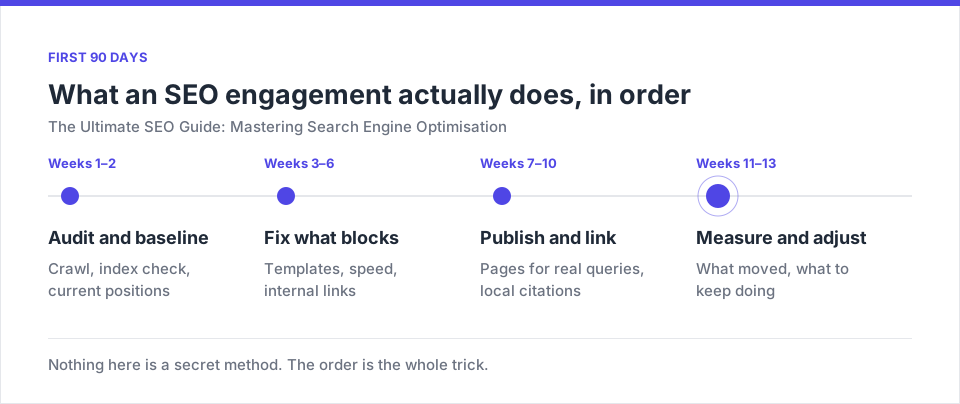
Implementation guidance for media optimisation should be incorporated into your monthly or quarterly roadmaps. Start with a media audit that prioritises high-traffic pages, services with rich media potential and local landing pages. From there, standardise file naming, alt text, video metadata and structured data across new and existing assets. For ongoing execution, consult our SEO services and contact a strategist who understands Manchester’s media landscape and local intent.
As we progress to subsequent sections, the focus shifts to how links, authority signals and digital PR amplify visibility. If you’d like a tailored media optimisation plan aligned with your Manchester market, reach out via our contact page and start turning media assets into measurable SEO assets.
Link Building And Digital PR In Modern SEO
Ethical link earning and strategic digital PR are foundational for durable search visibility. For Manchester-based organisations, these practices translate credibility into higher rankings, more qualified traffic, and measurable business impact. This section outlines practical, value-driven approaches to securing high-quality backlinks, earned media, and authoritative mentions while safeguarding trust and long-term growth. See how established SEO references describe link relevance, outreach etiquette, and the role of PR in search performance, then translate those insights into a Manchester-ready playbook with Manchester SEO Services at manchesterseo.ai.
Ethical Link Building: Principles And Practices
Modern link building centres on relevance, authority and user value rather than sheer volume. The objective is to place your content where it genuinely helps readers and where credible sources choose to refer to your insights. In practice, this means prioritising quality over quantity, pursuing contextual relevance, and aligning outreach with the interests of the audience you aim to serve in Manchester and beyond.
Key principles include transparency about your relationships, avoidance of manipulative anchor text patterns, and a clear method for establishing benefit to both parties. Industry guidance from Moz and Google’s documentation emphasises authentic signal generation: content that deserves citation, data-driven assets, and reputation-building activities that withstand scrutiny over time. See Moz's guidance on building credible links and Google's stance on ethical linking to anchor your approach.
- Audit your current backlink profile. Identify high-quality links to protect, toxic links to disavow, and opportunities where related content can earn respectable mentions.
- Define ideal link targets. Prioritise industry-relevant domains, local Manchester outlets, and authoritative trade publications where your content offers distinct value.
- Develop a data-driven outreach framework. Personalise outreach, present clear value propositions, and align with editors’ and reporters’ audiences.
- Create linkable assets. Publish data studies, practical guides, case studies and interactive tools that others are motivated to reference.
- Local relevance matters. Build relationships with Manchester press, local business associations and regional media to secure contextually appropriate citations.
- Monitor and maintain. Track new links, assess their quality, and refresh assets so they remain relevant and link-worthy over time.
In Manchester campaigns, link quality should be weighed by topical relevance, audience reach and the signal it sends about trustworthiness. Avoid shortcuts that rely on low-quality directories or artificial link exchanges. Robust authority emerges from credible sources, demonstrable expertise and steady content value. For practical frameworks, our team integrates link-building tactics with the broader SEO roadmap on manchesterseo.ai services to ensure local relevance and scalable outcomes.
Digital PR For SEO Value
Digital PR complements traditional outreach by prioritising stories, datasets, and narratives that attract earned media while building topical authority. The aim is not only to secure links but to create momentum that leads to sustained visibility across search and discovery systems. For Manchester audiences, digital PR can spotlight local case studies, industry analyses and community impact, while also contributing to national and international reach.
Implement a practical PR playbook that blends investigative data, industry insights and shareable assets. Focus on data-driven stories, credible visuals and expert commentary that raise awareness and invite credible coverage. For reference, explore credible explorations of digital PR practices and how they connect with SEO outcomes, alongside Moz and Google guidance on building credible signals that editors recognise as valuable.
- Identify compelling story angles. Look for insights that editors value, such as local market trends, client success metrics and industry benchmarks.
- Develop credible assets. Create data reports, infographics, and case studies that journalists can reference and reuse.
- Target appropriate outlets. Build a list of trade journals, regional publications and relevant blogs where your angle fits.
- Personalise outreach at scale. Craft tailored pitches that connect the outlet’s audience with your asset’s value, including concise summaries and clear lines of enquiry.
- Align PR with content strategy. Ensure PR efforts feed pillar content and topic clusters, creating evergreen assets that sustain links and visibility.
Digital PR should be a planned, repeatable process rather than a one-off event. When done well, it accelerates authoritative coverage and provides a credible stream of referring domains. For practical guidance, align PR workflows with the Manchester audience by integrating into our SEO services roadmap and local content calendar.
Local Manchester Link Opportunities
Local link opportunities are especially potent for Manchester campaigns. They bolster local signals, support map results and reinforce your business’s proximity to the community. Build a robust local network by engaging with business groups, chambers of commerce, regional publications and trusted directories that maintain quality and accuracy of listings.
- Local chamber portals and business networks that publish member stories and resources.
- Regional trade associations and event pages that feature speaker bios, case studies or event roundups.
- Local press and community outlets that cover industry developments, client wins and community impact.
- Local citations with consistent NAP data and service-area pages that reflect actual geography and offerings.
- University or research collaborations that yield credible data and shared assets.
These opportunities should be pursued with a clear value proposition and a plan that ensures content and assets remain relevant in the long term. For Manchester-specific guidance, explore our SEO services and local optimisation resources to tailor outreach to the city’s unique media ecology.
Anchor Text And Link Relevance
Anchor text should remain natural and contextually appropriate. Prioritise descriptive, topic-related phrases over exact-match keywords, and avoid over-optimised patterns that could trigger relevance concerns. In practice, diversify anchors by linking to pillar pages, product or service pages, and high-value assets that clearly convey the linked content’s purpose. For Manchester campaigns, local anchors should reflect locality and service area while maintaining readability and user trust.
Measurement, Risk And Compliance
Track the quality and impact of link-building and digital PR with a focus on outcomes rather than vanity metrics. Monitor referring domains for relevance, authority and traffic to Cincinnati-scale benchmarks, while paying attention to potential risk signals such as manipulative link schemes or sudden spikes in low-quality domains. Use Google’s guidance on safe linking and maintain an up-to-date disavow process when necessary. Combine analytics data with qualitative signals—editorial responsiveness, coverage quality and asset engagement—to gauge real-world impact.
Implementation should be integrated into your monthly SEO rhythm. Regularly review link profiles, refresh outreach templates, and retire assets that no longer deliver value. For tailored support, contact our Manchester team through the contact page or explore how our SEO services can shepherd your link-building and digital PR alongside broader local optimisation goals.
Local and International SEO: Local Signals, Maps and Localisation
Local optimisation extends beyond map rankings. For Manchester-based organisations, it means aligning local signals, service-area content and localisation strategies to ensure visibility where people search near you, in your city and across regions. This section explains how to maximise local presence in maps, local packs and localised content, while also laying out how to scale to international audiences through principled localisation and global structure. The guidance here complements the broader SEO framework at manchesterseo.ai, delivering practical steps you can apply to achieve measurable improvements in local and international search outcomes.
Local Signals You Should Prioritise
Local SEO success rests on signals that reflect proximity, relevance and trust. Start with a tightly managed Google Business Profile (GBP), then ensure your site, content and citations reinforce local intent. Core elements include accurate NAP data, employment of local categories, up-to-date service listings, and timely responses to customer feedback. In practice, consistency across channels and timely updates are more valuable than sporadic, generic optimisations.
- NAP consistency: Ensure name, address and phone number match across your site and major directories to avoid confusion and ranking friction.
- GBP completeness: Fill profiles with current hours, services, photos and posts; use local categories that reflect your primary offerings.
- Reviews and responses: Proactively manage feedback, respond professionally and use insights to improve service delivery.
- Local content relevance: Create service-area pages and city-focused guidance that address local questions and needs.
- Citations from credible directories: Prioritise quality sources that bolster local trust without introducing low-quality noise.
Optimising Google Business Profile For Local Impact
GBP is a central vehicle for local discovery, maps, and actions. Practical steps include claiming the profile, selecting accurate primary and secondary categories, detailing services, and publishing timely updates. GBP posts can highlight seasonal offers, events or service announcements, while the Q&A section can surface common queries with authoritative responses. Importantly, maintain a clear, evidenced narrative of your local authority and relevance. For Manchester organisations, accent local service expertise and proximity to key customer segments, then reflect those strengths on your site and in local assets.
Localisation Versus Local Optimisation For International Audiences
Local localisation involves tailoring content, metadata and experiences to reflect language, culture and regional norms while preserving a coherent brand narrative. For UK audiences, localisation often means UK English language variant, regional references and time-zone alignment. For global reach, plan a scalable structure that can accommodate multiple languages and regional pages. A practical approach combines local content clusters with globally evergreen assets, ensuring consistency of core messaging and data while enabling region-specific adaptations.
- Language targeting: Use country and language variants where appropriate, with clear navigation to regional assets.
- Regional content strategy: Develop hubs that address country-specific needs, regulations and market conditions without duplicating core content.
- Geo-targeted technical setup: Implement hreflang considerations to guide regional crawlers and users to the correct language/region versions.
- Structured data alignment: Deploy LocalBusiness schema for local pages and Service schema to clarify offerings across regions.
For principled localisation, you can explore schema-informed presentation and language-aware content strategies. A practical reference point is the LocalBusiness and Service schemas, which help search engines interpret your regional offerings. See Schema.org's LocalBusiness guidance for a standard reference that complements your on-page optimisation and GBP activity. LocalBusiness Schema.
Maps Optimisation: From Page to Place
Maps visibility benefits when you align in-location signals with robust on-page content and local citations. Ensure service-area landing pages reflect actual geography, incorporate local keywords naturally, and provide directions, contact points and service details that are easy to verify. The map-pack tends to reward profiles that demonstrate consistent, credible presence across the web and that deliver value to local searchers who seek nearby experts, suppliers or partners.
Measurement, KPIs And Governance For Localisation
Track local performance with a focused set of KPIs that connect to business outcomes. Monitor GBP interactions (views, calls, direction requests), map pack impressions, local organic traffic to service-area pages, and conversion rates for local inquiries. For international pages, compare regional metrics, assess global visibility, and watch for cross-regional traffic patterns. Regular audits of NAP consistency, GBP updates and local citations help maintain momentum against local competition and evolving search signals.
Implementation Roadmap: Localisation And Local SEO At Scale
- Audit local assets Validate GBP, web pages, citations and NAP consistency across core directories and maps services.
- Strengthen local hubs Create or optimise service-area pages and city guides that address local intent and proximity while linking to pillar content.
- Localise with care Implement language and regional variants where appropriate, ensuring content quality and cultural relevance.
- Manage GBP actively Maintain profiles, publish updates and respond to reviews to sustain trust signals.
- Measure and adjust Use GBP analytics, local traffic data and conversion signals to refine the localisation plan and resource allocation.
If you’d like hands-on support to design a Manchester-forward local and international localisation plan, explore the SEO services on manchesterseo.ai, or contact our team to tailor a roadmap that reflects your market.
Next, we turn to how structured data and rich results can elevate your site’s presence by enabling more expressive search listings and AI-assisted answers. For practical grounding, you’ll see how to implement schema and test how it supports local and international discovery.
Structured Data And Rich Results: Schema, Rich Snippets And AEO
Structured data and rich results are the bridge between your content and the evolving discovery channels that shape SEO today. For Manchester and broader UK markets, implementing schema and related formats helps search engines understand your content with greater precision, increasing the chances of appearing in informative SERP features and AI-driven answers. This section translates the theory of structured data into a practical, localisation-aware playbook that supports the four pillars of your strategy at manchesterseo.ai.
What Structured Data Does For SEO
Structured data uses a formal vocabulary, typically Schema.org, to mark up information on a page. When implemented correctly, it can influence how your pages appear in SERPs, including enhanced listings, knowledge panels and answer boxes. Importantly, structured data supports accessibility, localisation and clarity for both users and search engines. The result is improved visibility for local Manchester searches and more reliable discovery across platforms and devices.
Beyond rankings, structured data contributes to better comprehension by AI systems that surface answers in voice, chat and assistant interfaces. This alignment with AI-driven discovery reinforces the value of a well-planned schema strategy as part of your local and global SEO roadmap. For practical grounding, consult Google’s official guidance on structured data and schema markup, alongside Schema.org references. Google: Structured Data and Schema.org provide foundational references you can adapt to Manchester contexts.
Core Schema Types To Consider For Local Manchester Campaigns
Start with a focused set of types that deliver immediate, practice-ready value. The typical starting roster includes:
- LocalBusiness: Encapsulates core contact and location signals, helpful for GBP alignment and local search intent.
- Organization or Person: Establishes credibility and leadership signals for brand truth in local and national contexts.
- FAQPage: Addresses common Manchester queries and improves chances of appearing in rich snippets and Q&A formats.
- HowTo and Recipe (where relevant): Structures step-by-step guidance that can earn rich results and improve clarity for process-oriented searches.
- Article and NewsArticle: Supports topical authority and timely coverage with clear attribution and data fat content.
- BreadCrumbList: Reinforces site navigation and semantic relationships that aid both users and crawlers.
As you scale, extend schema coverage to include Service, Event, and Review where appropriate. Local examples might include service-area schemas for Manchester boroughs, event schemas for regional trade shows, and review snippets from satisfied clients. For practical references, review Schema.org guidance and Google’s practical examples to ensure your implementations align with current expectations.
Implementing JSON-LD On Your Pages
JSON-LD is the most maintainable method to embed structured data without disrupting page markup. Create concise, accurate blocks that describe page purpose and the surrounding context. A typical approach is to place JSON-LD within a script type="application/ld+json" tag near the bottom of the page body, or in the head where your CMS allows. For Manchester pages, include local identifiers such as city, region and service-area signals to reinforce proximity relevance.
- Audit existing content to identify pages that can gain from schema enhancements, prioritising high-traffic and high-conversion assets.
- Choose the right types based on intent and content format, starting with LocalBusiness, Service, FAQPage and Article as a core set.
- Build clean JSON-LD blocks that mirror the on-page content, avoiding over-annotation and avoiding misalignment with actual page data.
- Test and validate using Google's Rich Results Test and the Structured Data Testing Tool to confirm correct syntax and meaningful results.
- Maintain and update as offerings, locations and content evolve, ensuring data stays accurate and timely for Manchester audiences.
For a practical template, consider the following simplified JSON-LD snippet for a local service page. This example demonstrates LocalBusiness and Service contexts alongside a FAQ block to boost local intent capture. Replace placeholders with your real data and tailor to your offerings:
{
 "@context": "https://schema.org",
 "@type": "LocalBusiness",
 "name": "Your Manchester Service",
 "image": "https://example.com/photo.jpg",
 "address": {
 "@type": "PostalAddress",
 "streetAddress": "123 City Road",
 "addressLocality": "Manchester",
 "addressRegion": "Greater Manchester",
 "postalCode": "M1 1AA",
 "addressCountry": "GB"
 },
 "telephone": "+44-161-000-0000",
 "url": "https://manchesterseo.ai/services/your-service",
 "serviceType": "SEO Services",
 "areaServed": {
 "@type": "Place",
 "name": "Manchester"
 }
}
Rich Results And Answer Engine Optimisation (AEO)
AEO focuses on producing content that performs well in AI-assisted answers and rich-result environments. The goal is to structure content so machines can surface precise answers, while still delivering value to human readers. Key tactics include:
- Designing content blocks that directly answer typical Manchester questions, using FAQPage and HowTo patterns where appropriate.
- Using Question-oriented markup in FAQ sections to facilitate direct responses in search results and voice assistants.
- Providing clear data signals with Review, AggregateRating and Offer schemas to support trust signals and conversion cues.
Structured data does not guarantee a feature in every case, but it improves the engine’s ability to understand and rank your content, especially in a context where AI systems rely on explicit signals. For Manchester-focused teams, combine local relevance with evergreen assets that complement your pillar content. For further reading, Google’s and Schema.org’s guidance on AEO and related schemas provide practical context to implement within your existing editorial workflows.
Testing, Debugging And Validation
Validation is a continuous process. Regularly test new markup, monitor for data drift, and verify that updates remain accurate across devices and regions. Use Google Search Console enhancements, Rich Results Test, and the Page Experience signals alongside your regular technical audits. The aim is to detect and fix issues before they impact visibility or user experience. For Manchester campaigns, align validation cycles with local content releases and seasonal updates to ensure data accuracy remains consistent with live assets.
Want the numbers behind this? The analytics guide shows how organic traffic and the queries GA4 hides are rebuilt in Semalt.
Practical Roadmap For Manchester Campaigns
To operationalise structured data and rich results, integrate schema steps into your monthly SEO cadence:
- Plan and prioritise align schema work with pillar content, local landing pages and FAQ assets that address common Manchester questions.
- Develop a schema calendar schedule updates for key pages, ensuring seasonal content and service-area pages reflect current offerings.
- Embed JSON-LD consistently centralise schema blocks in your CMS templates to maintain consistency and scalability.
- Test and iterate run regular validation checks and compare SERP features performance over time to identify which schemas deliver the best lift.
- Monitor impact on user signals correlate schema-driven rich results with engagement, conversions and local lead quality to justify ongoing investment.
For a tailored, Manchester-focused plan, explore our SEO services and contact a strategist who understands your market. The path to enhanced visibility in 2025 and beyond combines robust structured data, thoughtful content architecture and intelligent measurement, all aligned with local realities and global discovery patterns.
Measuring SEO Performance: Analytics, KPIs and Reporting
Measurement is the bridge between activity and outcome in SEO. Building on the earlier sections that established strategy, pillars and local realities for Manchester markets, this part translates activity into credible business value. A disciplined measurement framework helps teams validate progress, justify investment, and continuously refine tactics across On‑Page, Off‑Page, Technical and Content Quality signals. The goal is to move from vanity metrics to insight that informs decisions, improves efficiency, and demonstrates real ROI for organisations working in Manchester and beyond.
To make measurement tangible, organisations should start with clear goals that tie to revenue, growth or customer value. From there, you map those goals to a set of leading and lagging indicators that are trackable in your analytics stack. This alignment ensures every SEO activity has a purpose, a forecast, and a way to demonstrate impact. For trusted reference points, see how industry leaders describe ROI in SEO and how to connect activities to business outcomes using credible data sources such as Moz and HubSpot.
Setting Measurable Goals And A North Star Metric
The process begins with defining a business-oriented north star for SEO. This is the single metric that best captures whether SEO is delivering meaningful value. Alongside the north star, establish a small set of supporting metrics that explain why the north star moved. In practical Manchester terms, you might anchor goals to increases in high‑quality organic leads, cost-per-acquired lead reductions, or growth in revenue from organic channels. A pragmatic starting point for goal setting is:
- North Star Metric: Organic revenue growth or qualified organic leads attributed to SEO initiatives.
- Leading indicators: Organic impressions, click-through rate (CTR) on core pages, traffic to pillar pages, and engagement metrics (time on page, scroll depth).
- Lagging indicators: Conversion rate from organic traffic, new customer or client acquisitions, and organic revenue growth.
- Contextual signals: Local intent signals, GBP interactions, and cross-channel assisted conversions.
- Governance cadence: Monthly reviews with quarterly calibrations to the KPI map as market conditions evolve.
Integrating the north star with local Manchester objectives ensures the measurement framework stays relevant to both the city’s market realities and broader business ambitions. For context on linking SEO to ROI, refer to HubSpot's and Moz's guidance cited in Part 1 and Part 2 of this series.
Key SEO Metrics Across The Funnel
A robust reporting approach tracks signals across the customer journey, from initial discovery to conversion. Organise metrics into stages that reflect how users interact with content and services in Manchester, and beyond local boundaries where relevant. The following categorisation helps teams prioritise and act quickly:
- Awareness and discovery: Impressions, non-brand and brand search visibility, and landing-page reach for pillar topics.
- Engagement and relevance: Click-through rate (CTR), time on page, scroll depth, and repeat visits on key clusters.
- Consideration and intent: Engagement with in-depth assets, downloads, and requests for consultations or more information.
- Conversion and value: Form submissions, product or service inquiries, booked consultations, and revenue impact from organic leads.
- Quality signals and trust: Organic performance on trusted assets, backlink quality, and mentions in credible sources.
For Manchester campaigns, localisation signals should be embedded within these metrics. Local content performance, GBP interactions and service-area page engagement can be early indicators of future conversions, while global topics help build enduring authority beyond the city. See Moz and Google resources linked earlier for foundational understanding of how signals translate into rankings and visibility.
Attribution, ROI Modelling And Data Integrity
Attribution remains one of the trickier aspects of SEO measurement. Most organisations employ a multi-touch or last-click model to attribute value, but real-world conversions often involve multiple channels and touchpoints. The key is to establish a transparent, business-focused attribution approach that can be communicated across stakeholders. A pragmatic stance is to use multi‑touch attribution for incremental testing while maintaining a clear, auditable trail of how organic interactions contribute to conversions over time. When possible, align online conversions with offline outcomes through CRM data and post‑touch attribution analysis.
ROI in SEO improves as you combine direct organic impact with the longer-term value of content assets. This means identifying not only immediate leads but also the lifetime value of customers acquired through organic channels. For grounding, review HubSpot's ROI frameworks and Moz's ROI discussions to structure your business-case narrative around measurable outcomes.
Practical Methods For ROI And Attribution
Implement a practical mix of attribution techniques to capture the contribution of SEO to your business. Consider:
- Model selection: Use a standard multi‑touch model for planning and a last-click model for execution reviews where appropriate.
- Data integration: Combine web analytics data with CRM and revenue data to understand downstream impact and lead quality.
- Incremental testing: Run controlled tests (e.g., content updates or page optimisations) and observe incremental changes in conversions over a rolling 90‑day period.
- Quality signals as proxies: Track link quality, content credibility signals and user satisfaction measures as proxies for long-term value.
- Seasonality and market shifts: Calibrate attribution and ROI calculations to reflect seasonal demand in Manchester and adjacent regions.
More detailed methodologies and case studies can be found in HubSpot's SEO ROI resources and Moz's ROI discussions, which provide practical templates for translating SEO activity into business value.
Building A Practical SEO Dashboard And Reporting Cadence
A well-constructed dashboard communicates performance to stakeholders quickly and clearly. Begin with a core dashboard containing the north-star metric, a few leading indicators, and lagging outcomes. Extend with cluster-level dashboards to track pillar pages and topic clusters, plus a local view focusing on Manchester GBP data and service-area pages. A typical monthly reporting cadence includes:
- Executive overview: One-page summary of performance against the north star and key KPIs, with a focus on business impact.
- Channel and content insights: Top performing pages, content gaps, and opportunities by pillar and cluster.
- Technical health checks: Crawl, indexation, speed, and core web vitals that influence velocity and coverage.
- Local signals and GBP: GBP interactions, local citations, and maps visibility metrics.
- Action plan: Prioritised fixes and experiments for the next period, aligned with business goals.
Dashboards should be living documents. Schedule monthly reviews, with quarterly deep-dives to recalibrate the KPI map to reflect market changes and business shifts. For Manchester teams, merge local performance data with broader content and technical signals to show how local work feeds global authority and vice versa.
If you’d like hands-on support to establish a tailored measurement framework, our Manchester team can map your business goals to an end-to-end analytics plan. Explore our SEO services for a local‑first, ROI‑driven approach or contact us via our contact page to speak with a strategist who understands your market.
Implementation Roadmap, Measurement And Local Optimisation For Manchester SEO
Having established the strategic framework across SEO pillars, keyword intent and content quality, the next step is to translate theory into a repeatable, locally aware programme. This part outlines an actionable implementation roadmap, governance practices and a measurement philosophy tailored to Manchester businesses. It connects the prior discussions on crawling, indexing, and on-page signals with practical execution, ensuring that every action contributes to observable business outcomes for Manchester SEO Services at manchesterseo.ai.
Turning Strategy Into An Operational Plan
Turning strategy into impact requires a structured cadence and clear ownership. Establish a quarterly blueprint that translates pillar and cluster priorities into a set of concrete experiments, content updates, and technical optimisations. Each initiative should be scoped with expected outcomes, required resources and a realistic timeframe. Align changes with local Manchester considerations while preserving scalability for national and international audiences. For practical grounding, our teams map initiatives to the four SEO pillars, ensuring content, technical health and external signals advance in concert.
- Baseline and quick wins. Start with a full site audit to identify critical gaps in crawlability, index coverage and on-page clarity, then prioritise changes that deliver the fastest, highest-value improvements.
- Plan by capability and impact. Schedule actions around three cohorts: quick fixes, mid-term optimisations, and long-range asset development aligned with pillar pages.
- Resource and role clarity. Assign a cross-functional squad (SEO strategist, content lead, developer, data analyst) with explicit responsibilities and deadlines.
- Implement, test, learn, scale. Execute changes in controlled sprints, measure impact, and iterate based on data to scale successful approaches.
Governance, Accountability And Cadence
Governance structures sustain discipline and continuity. Establish a monthly or quarterly SEO governance meeting that reviews performance, aligns priorities with business goals, and approves resources for upcoming cycles. Document decisions in a concise change log to ensure transparency for stakeholders and continuity across hires or agency partners. Crucially, tie governance outputs to tangible outcomes such as qualified leads, improved local visibility, and efficient use of budget across channels.
- Define roles: SEO lead, content owner, technical lead, analytics reviewer and client-side sponsor, with clear decision rights.
- Set cadences: monthly performance reviews, bi-weekly standups for sprint execution, and quarterly strategy refreshes.
- Produce artefacts: KPI dashboards, project briefs, implementation checklists and post-change retrospectives.
- Align with risk management: document dependencies, potential blockers and mitigations for both technical and content initiatives.
- Maintain compliance and accessibility checks as part of escalation criteria for changes.
Measurement Framework: What To Track And Why
A credible measurement framework distinguishes outputs from outcomes. Focus on metrics that reflect both activity and business value, with a bias toward actionable insights that drive decisions. Core categories include reach and visibility, engagement, conversion, and efficiency. For Manchester-focused campaigns, local signals and funnel progression matter as much as global ranking trends.
- Organic visibility: impressions, click-through rate (CTR) and average position for priority terms in Manchester and surrounding areas.
- Engagement and experience: time on page, scroll depth, bounce rate and page interactions on pillar and cluster content.
- Conversion and lead quality: leads generated from organic traffic, qualified opportunities, and downstream sales or bookings.
- Efficiency metrics: cost per acquisition (CPA) from organic channels, return on investment (ROI) and marginal cost per incremental lead.
- Signal health: number of indexed pages, crawl errors, and Core Web Vitals performance across critical pages.
Practical tooling includes Google Analytics 4, Google Search Console, Google Tag Manager, and performance dashboards that integrate data from SEO platforms and CRM systems. External references, such as HubSpot and Moz, provide frameworks for interpreting ROI and translating traffic into revenue, with HubSpot: SEO ROI offering pragmatic examples that resonate with Manchester teams.
Local Optimisation Playbook For Manchester
Local context drives relevance. The playbook focuses on service-area pages, GBP optimisation, local content alignment and reputation signals that help you appear in local packs and map results. Consistency in NAP data, accurate business categories, and timely responses to reviews strengthen trust signals for both users and search engines.
- Formalise local landing pages for key Manchester districts or towns with service relevance and clear conversion paths.
- Maintain a polished Google Business Profile with up-to-date hours, contact information and local posts.
- Encourage and respond to reviews; use them to highlight outcomes and client success stories.
- Reference local data sources and city-specific case studies within pillar content to boost local credibility.
- Synchronise local content with broader topic clusters to preserve evergreen assets while supporting local intent.
Local optimisation is not a stand-alone activity; it complements technical health, on-page clarity and content quality. For tailored, Manchester-specific roadmaps, our team can tailor a plan aligned with your market dynamics. Explore our SEO services to begin, or contact us directly to speak with a strategist who understands Manchester's search landscape: contact.
As you move toward execution, keep in mind that sustained success requires ongoing refreshes. Regularly review pillar pages, update data references, and adjust for shifts in local demand and competitive activity. For practical inspiration on measurement and governance, see the referenced resources from Moz and Google, and consider how these principles translate into a locally grounded plan for Manchester businesses.
Future Trends: AI, LLMs And The Evolving SEO Landscape
Artificial intelligence and large language models (LLMs) are reshaping how search engines interpret queries, surface information and interact with users. For Manchester-based organisations, this shift is not a distraction but a prompt to evolve strategies that blend human expertise with machine-assisted discovery. The preceding sections chart the enduring value of SEO, the mechanics of crawling, indexing and ranking, and the four pillars that keep optimisation coherent. This final part synthesises emerging trends, practical adaptations, and governance considerations to help you navigate the AI-driven future of search. For foundational context, see authoritative resources such as Google’s How Search Works, Moz’s beginner guides, and Schema.org annotations that underpin machine understanding. How Search Works, Moz: Beginner's Guide to SEO, and Schema.org offer practical grounding alongside our Manchester-focused roadmap at manchesterseo.ai and the local optimisation insights we share on the site.
What AI And LLMs Mean For SEO
LLMs are redefining search interactions, from conversational playbooks to enhanced summarisation and knowledge extraction. This reorientation means SEO must move beyond traditional keyword-centrism toward content architectures that are navigable, verifiable and highly aligned with user intent across devices and contexts. In practice, this translates into four priorities:
- Structured clarity over keyword density. Rich semantic signals and well-structured data help AI systems understand intent and surface accurate answers, even for ambiguous queries.
- Topic authority and data provenance. Content anchored in credible sources, transparent methodologies and verifiable data earns trust in AI-driven discovery as well as human readers.
- Adaptable content formats for AI surfaces. FAQs, How-To blocks, bulleted guides and data dashboards improve the chances of being featured in answer boxes and voice responses.
- Local context as a differentiator. Local signals, citations and service-area pages continue to reinforce proximity relevance in maps and local answer scenarios.
For Manchester marketers, the implication is clear: invest in authoritative content, robust data visualisation and localisation that can be consumed by humans and AI alike. The long-term value of SEO in an AI era will hinge on trust, accuracy and the ability to sustain relevance as search surfaces evolve. To stay informed, monitor official guidance from search engines and industry leaders, while applying these insights with a local lens through our SEO services at manchesterseo.ai.
Content Quality In An Era Of AI
Quality content remains the keystone. When AI tools surface answers, readers expect not only correctness but depth, context and transparency. The E-E-A-T framework (Experience, Expertise, Authoritativeness, Trustworthiness) takes on renewed significance as AI systems assess implicit signals of credibility. Your content strategy should integrate:
- Transparent author bylines and credentials that connect expertise to real outcomes.
- Clear sourcing and data provenance for claims, with accessible explanations of methodology.
- Verifiable case studies, diagrams and datasets that editors and AI can reference confidently.
- Accessible design and inclusive language to widen reach and compliance with best practices.
- Ongoing quality assurance that checks for accuracy, bias and timeliness in fast-moving topics.
In practical terms, this means transforming pillar content into ecosystems: topic clusters with rich, evidence-backed assets that teams can regularly refresh. For Manchester campaigns, local data, regional case studies and proximity-focused assets reinforce relevance while maintaining evergreen value for broader audiences. Our SEO services can help integrate E-E-A-T principles into editorial guidelines and governance routines.
AI-Driven Discovery and Measurement
As AI surfaces answers, measurement must reflect both traditional SEO outcomes and the quality signals that AI systems use to assess usefulness. Expect to track:
- Trust indicators: author credibility, data provenance and citation quality.
- AI surface metrics: frequency of appearance in knowledge panels, featured snippets and answer boxes.
- Human engagement: time on page, dwell time and comprehension measured across clusters.
- Conversion signals: lead quality and lifecycle value from organic and AI-assisted paths.
For practical governance, align your AI-informed measurement with existing dashboards, ensuring you can explain ROI to stakeholders. HubSpot’s ROI frameworks and Moz’s signal guidance provide useful templates for translating AI-enabled activity into business value. See HubSpot: SEO ROI and the Moz resources linked earlier for grounding in practice.
Practical Steps To Prepare For AI and LLM-Driven SEO
- Audit and annotate: Map core pages to intent, identify data sources, and ensure schema coverage that supports AI understanding.
- Invest in localisation and authority: Strengthen local signals, citations and case studies that can be referenced by AI tools and local readers alike.
- Plan content mutations for AI surfaces: Create FAQ, How-To, and data-driven assets designed for extraction by AI systems.
- Governance and quality control: Establish editorial processes that validate accuracy, transparency and bias mitigation in AI-assisted content.
- Measure with an AI-aware lens: Integrate AI-driven metrics into monthly reporting and align with your north star metrics for SEO.
Manchester teams can test new approaches in controlled pilots within our SEO services and use the outcomes to scale successful patterns across markets. For ongoing guidance, explore our resources and editorial guidelines on manchesterseo.ai Services and connect with a strategist via our contact page.