The reporting gap nobody admits to
Ask ten marketing leads across Spinningfields and MediaCityUK how much revenue organic search produced last quarter, and nine will read you a number from a dashboard they do not fully trust. The number is usually built on three shaky foundations: last-click attribution that hands credit to the final touch, session sampling that kicks in exactly when traffic gets interesting, and a keyword report where 60–90% of terms are hidden behind (not provided).
None of that is a scandal. Google stopped passing organic keyword data in referrers back in 2011 for legitimate privacy reasons, and GA4's sampling exists to keep queries fast on enormous datasets. The problem is that a decade of workarounds — stitching Search Console impressions to GA4 sessions in a spreadsheet, guessing which of eleven blog posts drove the enquiry — has become normal. Marketing teams have quietly accepted that they cannot answer the finance director's question properly.
The rebuilt Semalt platform attacks that gap from the measurement side rather than the reporting side. Instead of importing incomplete data and dressing it up, it captures search performance first-party, joins it to on-site behaviour at the session level, and keeps the join intact all the way through to a transaction or a form submission. That single design decision is what makes the rest of the platform useful.
(not provided)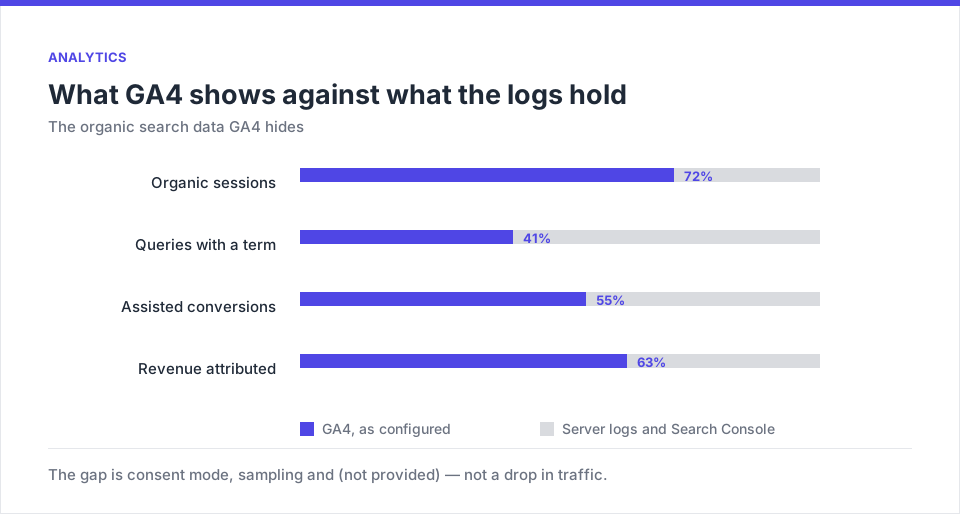
Keywords without (not provided)
Semalt reconstructs the query behind a session by combining three signals: the Search Console API (impressions, clicks, position, by page and query), its own SERP monitoring for the domains you track, and the landing-page fingerprint of the session itself. Where the join is unambiguous, the query is attached to the session directly. Where several queries plausibly map to the same landing page in the same hour, Semalt distributes them proportionally to click-through probability at the observed positions — and, critically, it labels which rows are modelled and which are exact.
That labelling is the part experienced analysts care about. Plenty of tools will happily present a modelled number as gospel. Semalt shows you a confidence flag per row, so when you tell your board that "hot tub hire Manchester" produced £14,200 last quarter, you know whether that figure is measured or inferred. In our experience with North West clients, roughly two thirds of organic sessions resolve to an exact query and the remainder are modelled within a tight band.
The practical effect on strategy is immediate. One Stockport-based B2B distributor we work with had been investing in content around a head term their agency loved. With query-level revenue visible, it turned out that 71% of pipeline came from a cluster of unglamorous long-tail phrases containing the word "next day" — a cluster nobody had ever built a page for.
Revenue attributed per URL
Traffic reports are easy. Revenue reports are where most SEO tools quietly bow out and hand you back to GA4. Semalt takes the opposite approach: connect your ecommerce platform or CRM once, and every organic session carries its downstream value with it.
| Connection | What Semalt reads | Typical setup time |
|---|---|---|
| Shopify / WooCommerce / Magento | Order value, currency, refunds, first vs returning customer | 10–15 minutes via app or key |
| HubSpot / Pipedrive / Salesforce | Deal stage, closed-won value, source URL of the originating session | 20–30 minutes, OAuth |
| Server-side event (custom) | Any value you post to the events endpoint with the session ID | A developer afternoon |
| Call tracking (Twilio, Infinity) | Call duration and outcome, matched to the session that generated it | Under an hour |
Because the value is joined to the session and not to the last page viewed, you finally see the difference between earning pages and converting pages. A guide in your resources section may convert almost nobody directly while being the entry point for a third of all closed-won deals. Under a last-click model, that guide looks like a candidate for deletion. Under Semalt's session-path model, it is the most valuable asset you own — and it usually turns out that the person who wrote it left the business two years ago and nobody has touched it since.
The question to ask in your next reporting meeting
"For each of our top 20 landing pages, what is the revenue per 1,000 organic sessions, and how has it moved quarter on quarter?" If your current stack cannot answer that in under a minute, the gap is not your team's competence — it is the data model underneath the dashboard.
Why unsampled data changes decisions
Sampling feels like a technicality until it costs you money. GA4's standard reports are typically unsampled, but the moment you build the segment you actually need — organic sessions, mobile only, Greater Manchester, landing on a specific template, excluding brand queries — you are into explorations, and explorations sample above threshold. The tell-tale sign is the number that shifts by 8% every time you reload.
Semalt processes every session in the reporting pipeline, so the segment you build is the segment you get. That matters most for exactly the analyses that drive investment: small but valuable cohorts. A dental group across Didsbury, Chorlton and Altrincham does not need to know that traffic is up 4% overall. It needs to know whether the Altrincham implant page converts better than the Chorlton one at a statistically usable sample size — a question that sampling turns into noise.
It also removes a subtle organisational problem. When two people pull the same report and get different numbers, trust in analytics collapses, and decisions revert to whoever argues most confidently in the meeting. Deterministic numbers are worth more than perfectly precise ones.
UK GDPR, PECR and the ICO
Post-Brexit, UK businesses sit under UK GDPR plus the Privacy and Electronic Communications Regulations, enforced by the ICO from its Wilmslow head office — which, for most of our clients, is a twenty-minute drive down the A34. That proximity does not change the law, but it does tend to focus minds.
Three points that matter when you deploy any analytics platform, Semalt included:
- Consent for non-essential cookies is not optional. PECR requires consent before storage or access on a device for anything beyond strictly necessary. Analytics is not strictly necessary, whatever your last agency told you. Semalt supports consent-gated loading and integrates with the common CMPs, so nothing fires before a lawful basis exists.
- Data residency is a question you should ask. Semalt offers EU/UK processing regions. Choose one, record it in your ROPA, and reference it in your privacy notice.
- Minimise by default. IP truncation, no capture of form-field contents, configurable retention. Set retention to what you genuinely analyse — for most SMEs, 26 months is more than enough, and shorter is easier to defend.
A practical Manchester note
If you operate a franchise or multi-site model — common across the region's fitness, veterinary and childcare groups — decide early whether each location is a separate controller or whether the group is one controller with locations as sites in a single Semalt property. Getting this wrong is not a technical problem, it is a contractual one, and it is far easier to fix in week one than in year two.
Segments that matter in Greater Manchester
Out of the box, most analytics tools segment by country and device. Neither tells a Manchester business anything actionable. The segments we build for regional clients on day one look like this:
- City centre versus Greater Manchester versus wider North West. Behaviour differs sharply: M1–M4 traffic skews mobile, short-session, high call intent; traffic from Bolton, Bury, Wigan and Rochdale skews desktop and researches longer before enquiring.
- Brand versus non-brand. The single most misleading line in most reports. If your organic growth is all brand, you are measuring the success of someone else's radio campaign.
- Metrolink-corridor postcodes. For retail, hospitality and clinics, proximity to a tram line is a better predictor of footfall conversion than distance in miles. Semalt lets you define custom geo groups from postcode districts rather than forcing you into standard regions.
- Match-day and event windows. If you trade anywhere near the Etihad, Old Trafford, the AO Arena or Deansgate, comparing a Parklife weekend against an ordinary one and calling it a trend will send you chasing ghosts. Build the calendar into your segments once and stop re-explaining spikes every month.
- Student cycle. With more than 100,000 students across the University of Manchester, MMU and Salford, the September and January intakes distort year-on-year comparisons for entire sectors — lettings, mobile repair, takeaways, gyms.
The report your board will actually read
Semalt's report builder is deliberately unglamorous, and that is a feature. The template we use for North West clients has four blocks and fits on one page:
- Revenue from organic, with and without brand Two lines, thirteen months, so seasonality is visible rather than assumed.
- The ten pages that moved most Ranked by change in revenue per 1,000 sessions, not by traffic. Growth and decay side by side.
- Queries gained and lost Exact-match rows only, with position change. This is the block that catches competitor movement weeks before anyone notices a ranking drop.
- What we changed and what happened Annotations pulled from the change log, so every intervention has a visible before and after.
Everything else — crawl stats, backlink counts, Core Web Vitals distributions — belongs in the working document, not the board pack. The discipline of separating the two is worth more than any individual metric.
See your own numbers before you decide anything
Connect a domain, let Semalt backfill your Search Console history, and look at revenue per URL for the last twelve months. It takes about twenty minutes and it tends to end several long-running internal arguments.
Sign in to Semalt Have us set it up for youSetting it up in an afternoon
- Create the property and add the tag One script, loaded behind your consent banner. On Shopify or WordPress it is an app or plugin install; on a custom stack it is a single line before
</head>. - Connect Search Console OAuth, read-only. Semalt pulls up to sixteen months of history so your first report already has a comparison period.
- Connect the money Ecommerce platform or CRM. Without this step you have a nicer traffic tool; with it, you have a commercial one.
- Define your geo groups and brand terms Fifteen minutes of setup that determines whether every future report is honest or flattering.
- Set the change log going Every deployment, price change, PR hit and Google update annotated. In six months this is the most valuable table in the account.
If you want the setup done to a standard rather than done quickly, our team handles it as part of a first-month engagement — see technical SEO or start with a free audit.
Where it does not help
An honest guide has to include this section. Semalt Analytics will not fix a business model. If your organic traffic converts at 0.3% because your pricing is uncompetitive in a transparent market, better measurement simply tells you that faster and in more detail.
It also will not replace product analytics. If you need funnel analysis inside a logged-in SaaS application, event-level session replay or cohort retention curves, you want a dedicated product tool and you should keep it. Semalt's domain is acquisition and the commercial value of acquisition.
And it is not a magic bypass around consent. If 40% of your visitors decline cookies, you will see modelled figures for that 40% in Semalt exactly as you would anywhere else — the difference is that Semalt tells you which rows are modelled instead of blending them silently into the total.
More in this series: Semalt AutoSEO: fixes without a sprint, Share of search, gaps and change alerts, AI keyword research: intent and revenue.
Questions we get asked
Does this replace Google Analytics 4?
For organic search reporting, in practice yes. Most of our Manchester clients keep GA4 for paid, email and referral, and treat Semalt as the source of truth for search. Running both for a quarter is a sensible way to build confidence in the numbers.
Is it compliant with UK GDPR?
The platform gives you the controls — consent gating, IP truncation, EU/UK residency, configurable retention. Compliance is still your responsibility: you need a lawful basis, a PECR-compliant banner and an accurate privacy notice. Nothing about Semalt makes that harder, and the residency options make it easier than several US-hosted alternatives.
How long until the data is useful?
Live sessions appear within about thirty seconds. Trend and cannibalisation analysis needs roughly four weeks of first-party history, though the Search Console backfill means your first report already has a year of context.
What does it cost compared with the usual suspects?
Pricing sits below the two market-leading enterprise suites for comparable domain and keyword volumes, and it includes the analytics layer that those tools charge separately for. Check current tiers on semalt.com — they change more often than this article does.
Can an agency manage several client accounts?
Yes. Workspaces with per-client permissions, white-labelled PDF exports and a single billing relationship. We run our entire North West client base this way.