Why most competitor reports are theatre
The standard competitor slide compares domain authority scores. Nobody has ever changed a budget because of a domain authority score, and rightly so — it is a third-party model of link strength, useful as a rough sorting mechanism and useless as a target. The report gets nodded through, filed, and repeated next quarter.
Useful competitor intelligence answers three questions a commercial director can act on. Are we gaining or losing ground in the searches that produce our revenue? Where specifically is the ground being lost? And what did they do to take it? Everything else — follower counts, traffic estimates presented to three significant figures, screenshots of their homepage — is decoration.
Semalt structures the module around those three questions, which is why it starts by making you define the competitor set properly rather than importing whoever came to mind in the kick-off meeting.
Choosing a defensible competitor set
Your search competitors are frequently not your business competitors. A Northern Quarter menswear independent competes commercially with two other independents and loses search traffic to ASOS, a marketplace and three affiliate "best of Manchester" listicles run by people who have never set foot in the city. A Bolton accountancy practice competes for clients with the firm down the road and competes in search with national comparison sites and the Institute's own directory.
Semalt builds the candidate list from data rather than opinion: which domains appear most often in the top ten for the keyword clusters you have defined, weighted by the commercial value of those clusters. You then curate it, and the curation matters. The set we recommend for a regional business is five domains:
- One aggregator or national brand that dominates your head terms. You are not going to beat it; you track it to understand which queries are genuinely contestable.
- Two genuine local rivals of comparable size. These are the ones whose gains come directly out of your revenue.
- One challenger — the newer, smaller domain growing faster than everyone. It is doing something that works, and it is small enough that what it does is legible.
- One adjacent player from a neighbouring category who has started ranking for your terms. This is where the surprises come from: the equipment supplier who started publishing guides, the franchise that added a Manchester location page.
Share of search as the headline metric
Average position is a bad headline number. It rewards ranking first for terms nobody searches and hides collapse on terms that pay the wages. Share of search fixes this: across your defined keyword set, weighted by volume and by the click-through typically earned at each position, what percentage of the available attention do you hold, and what do your rivals hold?
| Metric | What it tells you | How often to look |
|---|---|---|
| Share of search, total | Direction of travel in the whole market | Monthly |
| Share of search, commercial clusters only | Direction of travel in the searches that convert | Monthly |
| Share of Local Pack | Visibility in the three-result box that takes most local clicks | Monthly, by postcode district |
| Head-to-head win rate | Of the queries where both of you rank, how often you are above a named rival | Quarterly |
| Share captured by AI Overviews | How much of the market has stopped clicking at all | Quarterly |
Share of search has a useful property beyond SEO reporting: it tends to move six to twelve months ahead of market share. A steady decline while revenue still looks healthy is the clearest early warning a marketing team ever gets, and it is exactly the sort of number worth putting in front of a board that does not otherwise engage with search.
The keyword gap
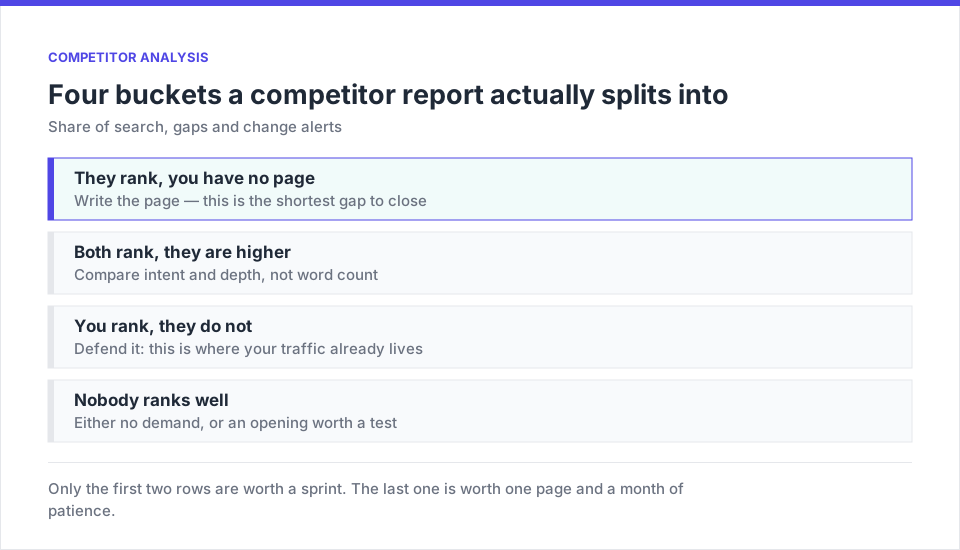
The gap report answers a narrow question well: which clusters do two or more of your competitors rank for, while you do not rank at all? Overlap across multiple rivals is the filter that makes this list usable — if three of them independently invested in the same territory, the demand is probably real.
Semalt sorts the gap by forecast revenue rather than volume and splits it into three actions. Content gaps mean you have nothing on the subject; you need a page. Coverage gaps mean you have a page but it addresses a different intent than the SERP rewards; you need a rewrite, not a new URL. Authority gaps mean your page is right and simply outgunned; you need links and internal support, and no amount of editing will substitute.
The reverse report is quietly more valuable and almost never run: clusters where you rank and nobody else does. That is your moat. It usually corresponds to something genuinely distinctive about the business — a niche service, a specific accreditation, an unusual stock range — and it deserves defending with the same seriousness as the gaps deserve attacking.
A pattern worth knowing
When a local rival suddenly appears across a whole cluster within a fortnight, they have almost never built authority that fast. Nine times out of ten they have published a large batch of programmatically generated location pages. Those pages typically perform for one to two quarters and then decay. Do not panic-copy the tactic; wait a quarter, watch the decay, and take the ground back with genuinely differentiated pages.
The backlink gap, North West edition
The backlink gap shows domains linking to two or more competitors but not to you. Filtered for quality and relevance, it is the most practical prospecting list in SEO, because these sites have already demonstrated willingness to link to a business exactly like yours.
For Greater Manchester businesses the recoverable list is more concrete than the usual advice implies. Regional press and trade titles — the Manchester Evening News business desk, Prolific North, BusinessLive North West, Place North West, Insider Media — run round-ups, appointments and funding stories continuously and cite sources that make themselves available. Chambers of commerce, pro-manchester, the Greater Manchester Chamber and sector networks list members. The universities publish partner and case-study pages for anyone doing genuine collaboration or offering placements. Charity partnerships, sponsorship of grassroots sport, awards shortlists and event listings all produce links that a national outreach campaign will never find because they are invisible outside the region.
Semalt scores each gap domain for relevance to your topic, an estimate of how attainable the link is based on how the competitor earned it, and traffic value. It also flags the links you should not chase: paid link farms, expired-domain networks and reciprocal directory schemes that a rival has bought. Seeing that a competitor's growth rests on 400 purchased links is genuinely useful intelligence — it tells you their position is rented, not owned, and that patience is a viable strategy. Our link building service works exclusively from the earnable half of this list.
Change monitoring: the early warning system
Semalt takes periodic snapshots of your competitors' key pages and alerts you to substantive changes: title and meta rewrites, pricing changes, new pages in tracked directories, service additions, schema changes, and shifts in internal linking that indicate a repositioning.
The commercial value is speed. When a rival drops their entry-level price by 15% on a Tuesday, you would rather know on the Tuesday than at the end of the quarter when your enquiry volume has already fallen. When they publish a page targeting a cluster you own, you have weeks to strengthen your position before their page settles. When they quietly remove a service line, that is a market signal worth interrogating.
Alerts run to a digest by default — a weekly email with anything material, and immediate notification only for changes on the pages you have marked as competitive fronts. The alternative, a real-time feed of every character that changed on twelve domains, gets muted within a fortnight and then everyone stops looking.
The Local Pack is a separate battlefield
For a large share of Manchester businesses, the three-result Local Pack takes more clicks than the entire organic list beneath it, and it obeys different rules. Proximity to the searcher, category selection, review velocity and profile completeness matter more than links or content depth.
Semalt tracks Local Pack composition from multiple simulated points across a city rather than from one notional centre, which is essential in a conurbation where the difference between M20 and M4 is the difference between two entirely separate result sets. You see which rivals hold the pack in each postcode district, how their review counts and ratings are trending, which categories they have selected, and where the geographic boundary of your own visibility sits. That boundary map is often the single most persuasive slide in a local SEO proposal: a business that believes it covers Greater Manchester discovering it is invisible three miles from its own front door.
Reading a core update through your rivals
When a core update rolls out, the instinct is to stare at your own graph. The graph will not tell you why. The pattern across the competitive set will.
If everyone in your sector fell and aggregators rose, the update changed how Google interprets the intent behind those queries, and the response is a content-format decision rather than a quality problem. If one rival rose while everyone else held flat, look at what they shipped in the preceding eight weeks. If you fell alone, the problem is yours, and the audit is the next stop rather than the update forum. Semalt overlays confirmed update windows on the whole competitor set, which turns three weeks of speculation into an afternoon of analysis.
Find out what your rivals took last quarter
Add five domains, define your clusters, and Semalt will produce the share-of-search history, the keyword gap and the backlink gap in a single pass.
Sign in to Semalt Book a competitor reviewWhere the line is
Competitor research means reading what is published in public: web pages, search results, backlink graphs, public review profiles. That is ordinary commercial research and Semalt does it at polite request rates that do not burden anyone's server.
It does not mean accessing systems you have no right to, harvesting personal data from staff pages to build outreach lists without a lawful basis under UK GDPR, or attempting to manipulate a rival's rankings. Beyond the legal exposure, negative tactics reliably rebound: the effort costs more than improving your own site, the effect is temporary, and Manchester's business community is a good deal smaller than it looks. Reputation travels faster here than any ranking.
A quarterly review that ends in decisions
- Share of search, thirteen months You and the five, commercial clusters isolated. One chart, one direction.
- What changed and who did it Every material competitor change from the alert log, grouped by rival, with an assessment of whether it worked.
- Top ten gaps by forecast revenue Split into content, coverage and authority so each has an owner and a cost.
- Our moat Clusters only we hold, with a note on what would threaten each one.
- Three decisions What we build, what we stop, what we watch. If the review does not produce three decisions, it was theatre after all.
More in this series: Semalt AutoSEO: fixes without a sprint, AI keyword research: intent and revenue, Winning the Local Pack across Manchester.
Questions we get asked
How many competitors should I track?
Three to six. One aggregator, two or three real local rivals, one fast-growing challenger, optionally one adjacent player. More than that and nobody reads the report.
Is this legal and ethical?
Reading public pages, public backlinks and public SERPs is standard research. Semalt does not touch private systems and neither should you. Personal data scraped from staff pages needs a lawful basis under UK GDPR — the safest answer is not to.
What is share of search, in one sentence?
Your slice of the total available search attention across a defined keyword set, weighted by volume and position value — and it usually predicts market share six to twelve months out.
How quickly will I be alerted to a rival's change?
Marked competitive fronts are checked daily and notify immediately; everything else lands in a weekly digest. Both thresholds are configurable.
My competitors are all national. Is any of this useful?
Yes, but the conclusion changes. The value becomes identifying which queries are genuinely contestable and which are structurally closed, so you stop spending on the closed ones. That decision alone often pays for the platform.