Why volume-first research fails
The traditional workflow is familiar to everyone: seed term, export ten thousand rows, sort by search volume, hand the top fifty to a writer. It produces content that ranks for nothing, or ranks for terms nobody buys from. We have inherited briefs where the flagship article targeted a 12,000-a-month head term with a SERP composed entirely of Wikipedia, the NHS and three national publishers. No amount of writing was ever going to win that.
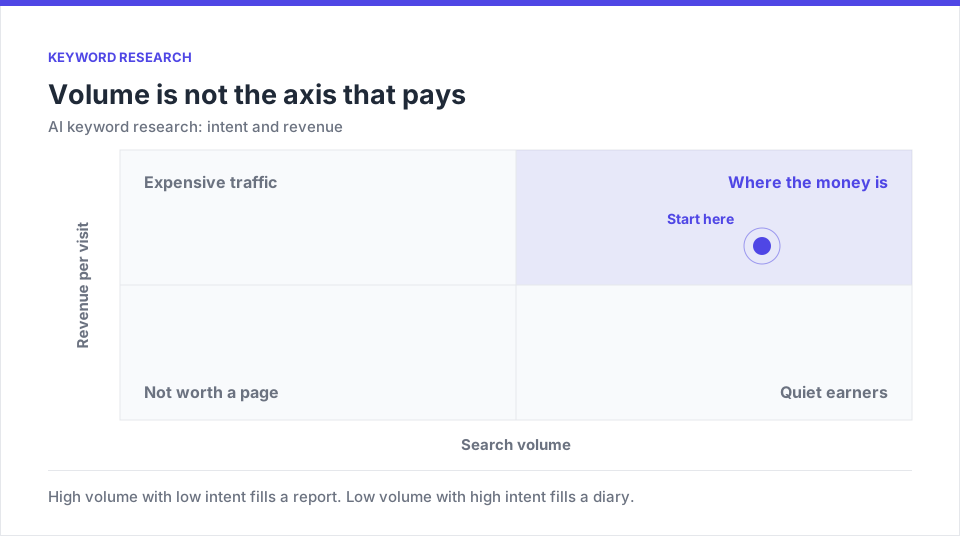
The failure is structural. Search volume is an average of a noisy estimate, it says nothing about intent, nothing about competitive reality, and nothing about whether the searcher has money in their hand. Sorting by it is sorting by the one column least connected to revenue.
The rebuilt Semalt research module inverts the order of operations. Expansion happens first and is treated as a commodity — Search Console, autocomplete, People Also Ask, related searches, competitor visibility and its own SERP index all feed in. Then four layers of judgement are applied before you ever see a list.
How intent is classified
Every query is classified against the SERP Google currently returns for it, not against a keyword pattern. This distinction matters: "SEO agency Manchester" and "how does SEO work" both contain the word SEO, and the results pages have almost nothing in common. Semalt reads the composition of the live SERP — how many results are commercial pages, how many are guides, whether a Local Pack is present, whether shopping units dominate — and assigns intent accordingly.
| Class | SERP signature | What you should build | Typical conversion |
|---|---|---|---|
| Transactional | Ads, product grids, pricing pages, few guides | Service or product page with proof and a clear next step | High |
| Commercial investigation | "Best of" lists, comparisons, review sites | Comparison content you control, or a placement on the lists that rank | Medium–high |
| Local | Local Pack, map, GBP profiles above organic | Optimised profile plus a genuinely local landing page | Very high |
| Informational | Guides, AI Overview, People Also Ask, video | Depth content for authority — expect assists, not conversions | Low direct |
| Navigational | Brand dominates, sitelinks | Nothing, unless the brand is yours or a competitor you can intercept | N/A |
The classifier also flags mixed intent — SERPs where Google is hedging between two interpretations. Those are opportunities, because a page that satisfies both readings can capture a position that neither pure-commercial nor pure-informational competitors hold.
Clustering by SERP overlap
Semalt groups keywords by measuring how many URLs their top-ten results share. If two queries return seven or more of the same pages, Google considers them the same job to be done and one page should target both. If they share two, they need separate pages, however similar the wording looks to a human.
This is the single most reliable defence against cannibalisation, and it produces results that regularly contradict intuition. "Emergency plumber Manchester" and "24 hour plumber Manchester" cluster tightly — one page. "Boiler repair Manchester" and "boiler installation Manchester" do not cluster at all, despite looking like siblings, because one SERP is full of emergency call-out services and the other is full of quote calculators and finance options. Build one page for both and you will rank properly for neither.
Difficulty adjusted to your authority
A universal difficulty score is a fiction dressed as a number. The same keyword is trivial for a national brand with 40,000 referring domains and impossible for a two-year-old local site. Semalt computes difficulty relative to your own profile: your topical authority in that subject, your existing rankings in the cluster, your link profile compared with the specific pages currently ranking, and the age and strength of those incumbents.
The output is a plain answer to a plain question — can we realistically rank for this, and roughly how long would it take? Three bands, each with a different strategic response:
- Reachable now (0–3 months). Terms where you already rank 5–20 and the incumbents are beatable with on-page work and internal links. Always start here; it funds everything else.
- Reachable with investment (4–9 months). Requires new content plus genuine link acquisition. Pick two or three clusters, not twelve.
- Not worth attacking. National publishers and aggregators hold the page. Consider getting listed on the pages that rank instead of trying to displace them — a mention in a Manchester Evening News round-up will outperform a year of trying to outrank it.
The uncomfortable but useful report
Semalt will show you which of your existing pages are competing with each other for the same cluster, ranked by lost revenue. Almost every site over 100 pages has at least three of these. Consolidating them is usually the fastest organic gain available, and it costs nothing but a decision about which page survives.
Forecasting revenue, not traffic
Traffic forecasts are easy to produce and easy to ignore, because "this cluster could bring 900 visits a month" answers no question a finance director has ever asked. Semalt joins the keyword model to your analytics and expresses the opportunity in money.
The arithmetic is transparent, which is the point: estimated volume × realistic click-through at the position you could plausibly reach × your measured conversion rate for that intent class × your average order value or lead value, discounted by the confidence band on each input. You can open every step, change an assumption, and watch the forecast move. Where the platform lacks your data — a brand new site with no conversion history — it says so and falls back to sector benchmarks, clearly labelled.
In practice, the forecast's main job is to end unwinnable internal debates. When one cluster models at £4,100 a month and the pet project models at £180, the conversation about which to build first becomes short.
The AI Overview reality check
Since AI Overviews became a standard feature of UK results, click-through on informational queries has fallen sharply, while commercial and local queries have been affected far less. Any research tool that ignores this is telling you about a search landscape that no longer exists.
Semalt records SERP features per keyword and per market — AI Overview, Local Pack, shopping units, video carousels, People Also Ask — and adjusts the expected click-through in the forecast accordingly. It also tracks which sources the AI Overview is citing for your target queries, which turns into a practical content brief: the pages being cited share a structure, usually a direct answer in the opening paragraph, a table of specifics, and clear evidence of first-hand experience.
The strategic conclusion for most regional businesses is straightforward. Chase informational rankings for authority and citation, but build the commercial plan on local and transactional intent, where the click still reliably reaches your site.
Manchester search language
National keyword tools flatten regional vocabulary, and Greater Manchester has plenty of it. Semalt's local expansion picks up the variants that actually get typed here:
- Neighbourhood over city. People search "gym Ancoats", "dentist Didsbury", "car valeting Prestwich" far more often than the city-wide term. Individually small, collectively larger than the head term, and dramatically easier to win.
- Postcode districts as modifiers. M20, M4, M33, SK1, WA14, BL1 — used routinely in searches for tradespeople, lettings and delivery.
- Landmark and transport anchors. "near Piccadilly", "near the Trafford Centre", "near MediaCity", "Metrolink" as a proximity proxy rather than an address.
- Regional phrasing. "tea" for the evening meal, "the precinct" for a shopping centre, "our kid" turning up in local commerce queries in ways no national tool anticipates.
- Borough names that are not Manchester. Salford, Trafford, Stockport, Bolton, Bury, Oldham, Rochdale, Tameside and Wigan are separate search markets with separate competitive sets. Treating Greater Manchester as one keyword universe is the commonest local-SEO mistake we correct.
A worked example: a Chorlton clinic
A private physiotherapy practice on Barlow Moor Road, one location, modest domain authority, competing against two national chains and a hospital group. Volume-first research would have handed them "physiotherapy Manchester" — high volume, dominated by aggregators and the chains, unreachable inside two years.
Semalt's map produced something more useful. Nineteen reachable clusters, of which the top four were: sports injury rehabilitation with a running-specific angle (strong local demand, weak commercial competition, boosted by the Manchester running scene); post-operative knee rehab (transactional intent, referral-adjacent, almost no local content); "physio near me" style local intent within a three-mile radius of M21 (Local Pack dominant, GBP work rather than content); and a small cluster around workplace posture assessments aimed at the city-centre office market.
The revenue model put the four clusters at roughly £6,800 a month of realistic new patient value at achievable positions. The work was eleven pages, not eighty; two of the four required no new content at all, only Google Business Profile work and internal linking. Nine months later the practice ranked in the Local Pack across three postcode districts and had stopped buying the head-term ads it had been losing money on.
Map your own clusters before writing another word
Connect Search Console, add three competitors, and let Semalt produce the reachable-now list. Most teams find between five and fifteen clusters they already half-rank for and had never noticed.
Sign in to Semalt Our keyword research serviceFrom cluster to a brief a writer can use
The gap between research and published content is where most programmes stall. A cluster export handed to a copywriter produces an article about keywords rather than an article about the subject. Semalt closes that gap by generating a brief from the SERP rather than from the keyword list.
Each brief carries the elements that the currently ranking pages have in common: the questions they all answer, the entities they all mention, the format Google is rewarding (comparison table, step sequence, case study, calculator), typical depth, and the schema types present on the winning results. It also lists what none of them do — the gap you can occupy. On local service queries that gap is very often the same thing: none of the ranking pages contain a real price, a real timescale or a named human being.
What the brief deliberately does not do is write the page for you. Generated text that regurgitates the same ten sources is exactly what Google's helpful-content systems are built to discount, and a Manchester business competing on trust cannot afford to publish it. The brief tells your subject-matter expert what to cover; the expert supplies the experience that makes the page worth ranking. If you want an editorial process built around that division of labour, our content strategy service is designed exactly this way.
Seasonality and the Manchester calendar
Annual averages hide the shape of demand, and the shape is where the money is. Semalt plots twelve months of demand per cluster and flags the lead time between interest and purchase, which for most considered services in the region runs at six to ten weeks.
Locally that produces a calendar worth planning against. Student-driven demand — lettings, furniture, mobile repair, gyms, takeaways — peaks in August and again in early January, so the content and the profile work must be finished by mid-July. Wedding and events suppliers see their research peak in January for a summer booking. Roofing, drainage and boiler queries spike within hours of the first serious autumn storm, which means the page has to be indexed and ranking in September, not written in November. Hospitality around the arena and stadium districts lives and dies by the event calendar, and city-centre B2B demand collapses for the fortnight either side of Christmas in a way that makes January year-on-year comparisons meaningless unless you segment them out.
Publishing eight weeks ahead of the curve is not a clever tactic; it is the minimum required for a new page to be crawled, indexed and settled into position before the demand arrives.
The twenty-minute weekly routine
- Check gained and lost queries Exact-match rows, week on week. New queries you never targeted are free briefs; lost queries are early warnings.
- Scan striking distance Anything sitting 5–15 with commercial intent. Usually an on-page fix and three internal links, not a new article.
- Review new SERP features An AI Overview appearing on a target query changes its value. Reprioritise rather than re-write.
- Confirm the cluster map still holds Google reinterprets intent over time; Semalt re-crawls SERPs and flags clusters that have split or merged.
- Move one thing into production A routine that never ends in a deployment is a hobby. One page, one improvement, every week.
More in this series: Semalt AutoSEO: fixes without a sprint, Share of search, gaps and change alerts, Winning the Local Pack across Manchester.
Questions we get asked
Is this just autocomplete with extra steps?
Expansion is the commodity part and every tool does it. The value here is intent classification against live SERPs, clustering by result overlap, difficulty relative to your own authority, and a forecast denominated in money.
Does keyword research still matter with AI Overviews?
More than before, but the target moves. Informational clicks are leaking; local and transactional clicks are not. Semalt flags which of your targets carry an Overview so you can invest accordingly.
How accurate is the revenue forecast?
Directional for new territory, reasonably tight for clusters where you already have presence and twelve months of connected conversion data. Every assumption is visible and editable, which is more useful than false precision.
Can it handle multiple locations?
Yes, and it should. Separate keyword maps per borough with shared cluster definitions, so you can see that Stockport is winnable while Manchester city centre is not, and staff the plan accordingly.
Does it work for B2B with tiny volumes?
That is where it earns its keep. When a cluster has forty searches a month and a £30,000 contract value, volume-based tools discard it and revenue-based ones surface it.