The real bottleneck
Here is a scenario every in-house marketer in Greater Manchester will recognise. The audit lands in March. It identifies 240 pages with truncated titles, 90 missing structured data, a redirect chain from a 2023 migration and forty internal linking opportunities. Everyone agrees it should be fixed. The developer is contracted three days a month and is currently rebuilding checkout. The agency retainer covers strategy, not implementation. By September, eleven of the 240 have been fixed, and the audit has been re-run because it is now out of date.
Nothing in that story is anybody's fault. It is a resourcing structure that most SMEs share, and it is why so much SEO advice never converts into ranking movement. The work is not hard; it is numerous, low-status and always the second priority.
AutoSEO in the rebuilt Semalt platform exists for exactly that category of work: changes that are individually trivial, collectively significant, entirely reversible, and requiring no product judgement.
What AutoSEO actually does
| Task | What AutoSEO does | Risk |
|---|---|---|
| Titles & meta descriptions | Rewrites truncated, duplicated or missing tags using the page's own content and your templates, within pixel limits | Low — fully reversible |
| Structured data | Generates and maintains Product, LocalBusiness, FAQ, Article, Breadcrumb markup; keeps it valid as Google's requirements change | Low |
| Internal linking | Inserts contextual links from relevant pages to under-linked money pages, respecting a per-page cap | Medium — approval gate recommended |
| Redirects | Detects new 404s, proposes the best-matching destination, flattens chains created by other changes | Medium |
| Canonicals & parameters | Resolves duplication from filters, sorting and tracking parameters | Medium |
| hreflang | Maintains the return-tag graph across language versions as pages are added or removed | Low |
| Image alt text | Generates descriptive alt text from image content and page context, in your language and register | Low |
| Sitemaps & robots | Keeps sitemaps aligned to the real indexable set; proposes disallow rules for crawl-wasting URL patterns | Low–medium |
Implementation happens either through a CMS integration (WordPress, Shopify, Magento and the common headless setups), through an edge worker for sites that cannot take a plugin, or by opening a pull request against your repository if your team would rather review changes as code. That last option converts most sceptical developers, because the change arrives in the workflow they already trust.
The propose → approve → apply → watch loop
- Propose A monitor detects an issue — a new 404 with inbound links, a title truncated after a product-name change, schema invalidated by a Google requirement update. AutoSEO drafts the fix.
- Approve Depending on your rules, the change is applied automatically, queued for one-click approval, or sent to a named reviewer. Rules can differ by template: automatic on blog posts, always-approve on checkout.
- Apply The change goes live with a timestamped diff. Nothing is applied silently and nothing is applied outside the categories you enabled.
- Watch AutoSEO monitors the affected URLs for impressions, position and revenue. If the metrics move the wrong way beyond a threshold, it flags the change and offers a rollback — frequently before a human would have spotted it.
That fourth step is what separates automation from recklessness. A tool that applies changes and walks away is a liability. A tool that keeps score on its own work, and admits when a change did not help, is a colleague.
Guardrails that make it safe
- Scope by URL pattern. Automation on
/blog/*and/products/*, hands off/checkout/*and legal pages. Set once, enforced always. - Rate limits. A cap on changes per day. Fifteen title rewrites a day is maintenance; four hundred in an afternoon is a site-wide event that makes attribution impossible and looks alarming in the logs.
- Brand and tone rules. Forbidden words, mandatory phrasing, British spellings, how the company name must be written. Nobody wants a generated meta description calling their business a "solutions provider".
- Staging first. Where a staging environment exists, changes can be applied and validated there before production. For a site turning over serious money, this is not optional.
- Full audit trail. Every change: what, when, why, which rule, who approved. Export it for your own change management — and for the awkward conversation six months later about why a tag says what it says.
- Kill switch. One control halts all automation and, if you want, reverts everything applied in a chosen window.
Set the rate limit before you set anything else
The most common way automation goes wrong is not a bad individual change. It is a thousand simultaneous good changes, which makes it impossible to tell what caused the movement in the graph two weeks later. Slow automation is measurable automation.
What we never automate
An honest guide to automation has to be specific about its limits. The list below is what we keep in human hands on every client account, regardless of how well AutoSEO performs elsewhere.
- Body content on commercial pages. Generated prose competing in a market where trust is the product is a false economy. The expert's experience is the thing that ranks.
- Anything touching price, availability or legal claims. Automated schema stating a price that contradicts the page is a trading standards problem, not an SEO problem.
- Link acquisition. Outreach at scale is spam with better tooling. Links come from relationships, sponsorship, genuine expertise and being worth citing.
- Google Business Profile categories and service areas. High leverage, easy to get suspended, worth a human ten minutes.
- Redirect decisions during a migration. AutoSEO proposes the mapping and it is usually right; a person signs it off. The cost of being wrong is measured in quarters.
Working with a development team that hates this idea
Scepticism about a third-party tool editing production is healthy, and we would be worried about a development lead who did not raise it. The objections are predictable and each has a straightforward answer.
"It will conflict with our deploys." Changes are applied at the CMS or edge layer, or as pull requests. In pull-request mode, your CI runs, your reviewers review, your process is untouched. "We will not know what changed." Every change is diffed and exportable; it is a better trail than most manual CMS edits leave. "It will break something at 2am." Scope rules, rate limits and the kill switch exist precisely for that, and rollback is one click rather than an emergency deployment.
The pull-request mode is worth pushing for even when it is not strictly necessary. It converts an argument about trust into a normal code review, and after a month of accepting sensible pull requests, the argument stops happening.
One Oldham manufacturer, six months
A family-owned industrial supplier on the edge of Oldham, 3,400 products, a Magento build maintained by one contractor who visits on Thursdays. Their situation is the one AutoSEO was designed around, and it is far more typical of the North West economy than the venture-funded scale-ups that dominate marketing case studies.
The audit found the usual picture. Roughly 2,100 product pages carried the manufacturer's raw part description as the title tag, which meant duplicate or meaningless titles across whole categories. Structured data existed on 40 products, added by a plugin that had since been disabled. Three years of discontinued lines returned 404s while still receiving inbound links from trade directories and old quotes. Category pages linked downwards but nothing linked back up, so the pages with the best margins sat five clicks deep.
None of that needed strategy. It needed someone to spend six weeks doing tedious work, and there was nobody to spend them. AutoSEO ran in observe-only mode for a fortnight while we tuned the title template — part number, product type, key specification, brand — then applied at twenty pages a day so movement stayed attributable. Schema generation followed. The 404s were mapped to their nearest current equivalent, with the contractor signing off the mapping in a single Thursday session rather than building it himself. Internal linking came last, under approval, capped at three inserted links per page.
Six months later: 2,100 unique, informative titles; valid Product schema across the catalogue; 340 previously dead URLs redirected to live products, recovering traffic that had been arriving and bouncing for three years; and a click depth of two to the highest-margin categories. Organic sessions rose by a bit under half, and the commercially meaningful number — quote requests from organic search — roughly doubled. The contractor's involvement across the whole period was about four hours.
Nothing in that programme was clever. It was maintenance that finally happened, on a site where it otherwise never would have.
The arithmetic that justifies it
Take the audit backlog from the opening scenario: 240 metadata fixes, 90 schema additions, 40 internal links, a redirect chain and ongoing 404 maintenance. Done manually and carefully, that is comfortably 40–60 hours of skilled work, and in an SME it will be spread over six months during which the backlog regrows.
AutoSEO clears the reversible portion in a fortnight of rate-limited application and then holds the line permanently — the 404 that appears next Tuesday is caught next Tuesday, not in next year's audit. The hours saved are not the main benefit, though. The main benefit is that the fixes exist at all, months earlier, compounding while your competitors' equivalent backlogs sit in a shared drive.
Set against that: the platform subscription, a couple of hours of rule configuration, and a monthly review that takes twenty minutes. For most Manchester SMEs, the comparison is not close — and it frees the retained SEO time for the work that actually needs a brain, which is the point of the exercise. If you would rather someone configured and supervised it for you, that is part of how we run technical SEO engagements.
Start in observe-only mode
Run AutoSEO for two weeks without letting it apply anything. Read what it would have done. It is the cheapest possible way to find out whether you trust it.
Sign in to Semalt Ask us to supervise itA cautious 90-day rollout
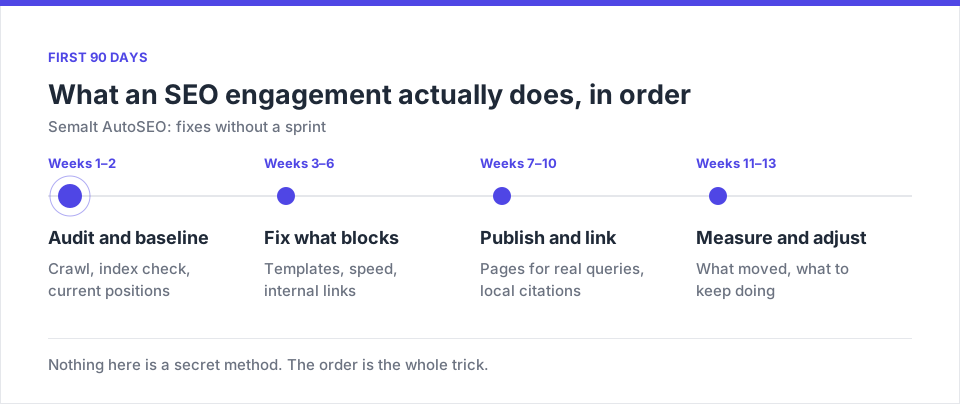
| Phase | What is enabled | What you are checking |
|---|---|---|
| Days 1–14 | Observe only. Nothing applied. | Would you have approved each proposal? Tune the tone and brand rules. |
| Days 15–30 | Metadata, alt text and schema on non-critical templates. 20 changes/day cap. | Impressions and click-through on affected URLs versus a control set. |
| Days 31–60 | Internal linking and 404 redirect handling, under approval. | Crawl depth to money pages, restored traffic on previously broken URLs. |
| Days 61–90 | Canonicals, parameters, sitemap and hreflang maintenance. Approval gates relaxed where the record justifies it. | Crawl waste, index coverage, and whether any rule has produced no measurable benefit — retire those. |
Is this against Google's guidelines?
No, and it is worth being precise about why, because the question comes up in every kick-off. Google's spam policies target manipulative behaviour: scaled content abuse, link schemes, cloaking, deceptive redirects. They do not prohibit automating site maintenance. Every large ecommerce platform in the world generates titles, canonicals and structured data programmatically; nobody considers that a violation, because the output is accurate and serves the user.
The line is intent and accuracy. Automatically generating valid Product schema that matches the visible price is maintenance. Automatically generating review markup for reviews that do not exist is a manual action waiting to happen. AutoSEO's rule set is built on the right side of that line, and the categories it refuses to touch — body content on commercial pages, link acquisition — are refused for exactly this reason.
More in this series: Share of search, gaps and change alerts, AI keyword research: intent and revenue, Winning the Local Pack across Manchester.
Questions we get asked
What if a change hurts rankings?
Every change is diffed and reversible in one click. AutoSEO monitors the URLs it touched and flags adverse movement itself, usually before anyone notices manually.
Does it work with WordPress and Shopify?
Yes, via integrations. Magento, headless builds and bespoke stacks are handled by edge worker or pull request. If you cannot install anything anywhere, you can still use proposal mode and apply changes by hand.
Do I still need an SEO consultant?
For judgement, yes: what to build, which markets to enter, how to position, what not to publish. Automation removes the part of the job that was never worth a specialist's hourly rate.
Can it manage several sites at once?
Yes — rules are set per property, and agencies typically run a shared baseline with per-client overrides. It is the only sane way to maintain twenty client sites to a consistent standard.
What happens if we cancel?
Applied changes stay in your CMS or repository; they are your content, not a hosted overlay. Edge-worker changes revert when the worker is removed, which is why we prefer CMS or repository modes for anything you would want to keep.